
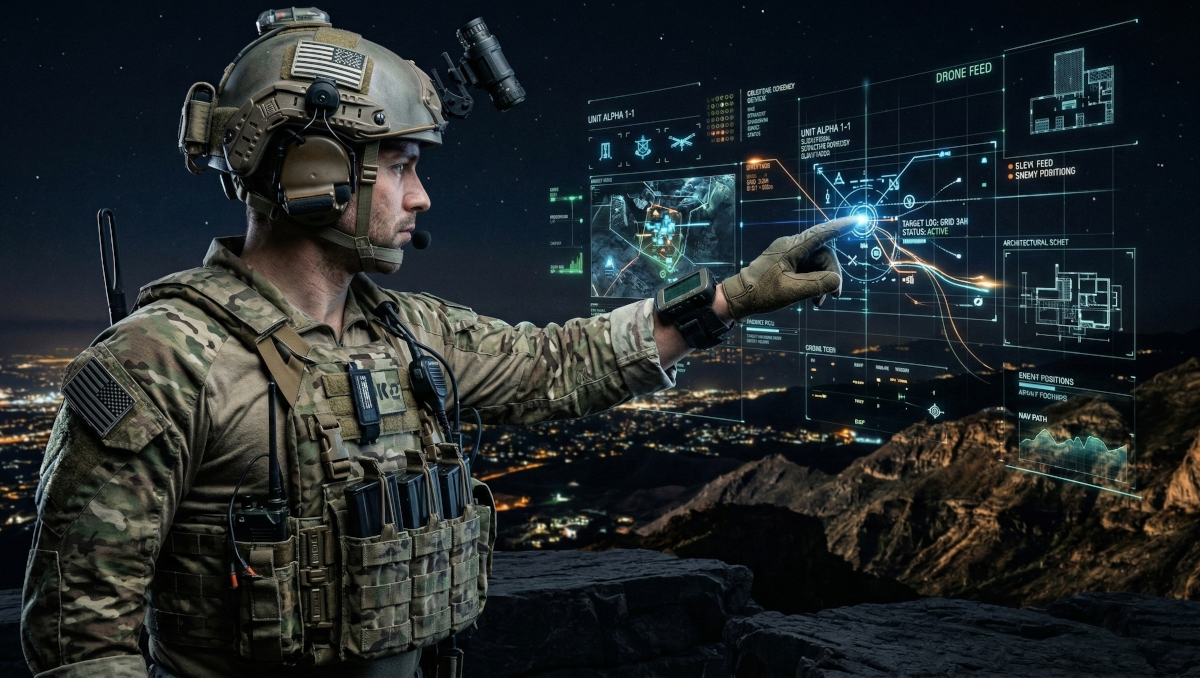
The Army is evolving its intelligence gathering to outpace modern threats. Andrew Evans joins Tom Spahr to discuss the Army G-2’s Strategy and Transformation Office, which is tasked with fielding intelligence capabilities at the pace demanded by today’s operational environment. This requires a cultural that embraces risk and places “minimum viable products” into the hands of soldiers early in the development process. While specialized classified tools remain vital, the future of intelligence increasingly relies on managing a vast ecosystem of data—including stratosphere-based sensors and open-source information. Ultimately, this transformation is about moving faster and more ethically to provide commanders with a decisive edge on the battlefield.
The GAO published in 2024 a report about how we were doing broadly with our acquisitions… it is now an average of 11 years to deliver a wartime capability… we don’t have 11 years.
Podcast: Download
Subscribe: Apple Podcasts | Spotify | Amazon Music | Android | Pandora | iHeartRadio | Blubrry | Podchaser | Podcast Index | TuneIn | Deezer | RSS | Subscribe to A Better Peace: The War Room Podcast
Andrew Evans is a retired Army officer and pilot who flew intelligence collection aircraft for years before moving to the Pentagon. He is the Director of the Strategy and Transformation Office of the Deputy Chief of Staff for Intelligence, G2, and former Director of the Intelligence and Surveillance Reconnaissance Task Force, or ISR Task Force. He has a master’s degree from Harvard Business School and has been working intelligence and acquisitions challenges in the Pentagon since around 2018.
Thomas W. Spahr is the DeSerio Chair of Strategic and Theater Intelligence at the U.S. Army War College. He is a retired colonel in the U.S. Army and holds a Ph.D. in History from The Ohio State University. He teaches courses at the Army War College on Military Campaigning and Intelligence.
The views expressed in this presentation are those of the speakers and do not necessarily reflect those of the U.S. Army War College, U.S. Army, or Department of War.
Photo Credit: Created by Gemini




The below is from the written introduction to our podcast above:
“This requires a cultural that embraces risk and places ‘minimum viable products’ into the hands of soldiers early in the development process. While specialized classified tools remain vital, the future of intelligence increasingly relies on managing a vast ecosystem of data—including stratosphere-based sensors and open-source information. Ultimately, this transformation is about moving faster and more ethically to provide commanders with a decisive edge on the battlefield.”
Question:
If the “battlefield” can be considered cognitively; that is, as being in the minds of the populations of the world (to include in the minds of our own populations here at home) — and if the goal is to move faster, more decisively and more ethically in this such “battlefield” — then what “minimum viable (cognitive/ideological?) products” might we “place in the hands of soldiers early in the development process,” which might help our soldiers achieve victory in this such battlefield?
Or do such things as intelligence, innovation, and integration no longer take into serious consideration such human domain matters as I address above; this, given the current trend toward kinetic, rather than via other means, ways to support — and/or to achieve — victory?
Another way of looking at the matters that I present above, this may be by looking at the first sentence of our written introduction to this podcast, as follows:
“The Army is evolving its intelligence gathering to outpace modern threats.”
Thus, to ask:
Specifically as relates to the human domain/the cognitive realm, can it be said that the Army is “evolving its intelligence gathering (how?) to outpace modern threats?” (Any unclassified explanations and/or examples might prove very useful here.)
Or, for various reasons, which might be important for someone to articulate, might it be said that (a) the Army has no such human domain/cognitive realm “evolving its intelligence gathering to outpace modern threats” objectives and/or projects, and, thus, (b) has no such “evolving its intelligence gathering to outpace modern threats” experimental/evolutionary “irons in the fire?” (Or, more correctly, and again for various reasons that someone should articulate, has no such capability — in the human domain/the cognitive realm — to “evolve its intelligence gathering to outpace modern threats?”)
As to the matters that I present above, consider the following:
“In the post-GWOT shift to strategic competition, the service has reverted to a focus on HUMINT soldiers for interrogation, a capability reduction that will ultimately lead to obsolescence. Training opportunities on basic to mid-level tradecraft and operational skills that would enable collectors to safely meet and engage with sources are being systematically reduced across the force. Critically, this trend threatens the Army’s ability to understand and influence populations in contested environments where such understanding proves decisive, leaving the force especially vulnerable during Phase 0 operations across multiple fronts (as is currently the case). By reducing the Army’s human intelligence collection capability, field commanders are left with no means to gather intelligence from the people immediately outside their gates.” (See the Feb 18, 2026, Small Wars Journal article “Mapping the Human Terrain: The Enduring Role of Human Intelligence in the U.S. Army.”)
“Further, where DoD and the US government have to compete in the human domain without sacrificing key values or crossing ethical lines, our adversaries often show no such constraint, as evidenced by the growing number of examples of their efforts to destabilize and paralyze free societies. Small wonder then that the human domain is increasingly attracting adversary attention and gaining importance within the context of great power competition—especially for Russia and China over the last decade, which have recognized that the United States does not have an information or human domain grand strategy and has struggled to adapt to this domain. Because military force is most consistently discussed in hard-power terms, DoD has been slow to adapt its training to soft-power tactics and requirements. Kinetic power has not become irrelevant, but adversaries are increasingly engaging US forces and the American public directly via soft-power tactics, intending to sow discord and undermine democracy. Both Russia and China have actually adapted to this new environment faster than the United States.” (See the June 14, 2021, Modern War Institute article “We Ignore the Human Domain at Our Own Peril.”)
Thus again to ask: (a) Specifically as relates to the human domain/the cognitive realm, (b) can it be said that the Army actually can, and/or actually has or is, (properly) “evolving its intelligence gathering (how?); this, “so as to outpace modern threats?” (Such as those addressed and discussed immediately above)?
Great points about innovation in military intelligence. A culture that accepts some risk is often necessary for real progress.
11 yrs to develop a sophisticated platform..much less for simplier items such as anti-drone. The issue will always be the legal contracting system and manufacturing physics which everyone discounts.
Orville Redenbacker took 32 yrs to develop his popcorn. McDonald’s 5 yrs for the McNuggets and Charmin 5 yrs for their new tear strip toilet paper. The issue is no one else makes what the DOD buys for tech systems like anti hypersonic missile defense, or attack jets. The specs we requires to have significant advantage and personnel safety are costly as well. We could go cheaper and faster but then would less systems like China and Russia and we see how well those work.
Can improvements be made YES!! However, to believe we develop superior technology rapidly with our capitalist system much much faster and cheaper is dillusion. How did we get PATRIOT, B2 Bomber, our fighter Jets, Tomahawk, etc…Deliberate development. The system has built in processes to go faster but it won’t be cheaper or better. When the shooting starts, yes – faster less tested is acceptable but for the long run against threats, deliberate is often the best way.
People are just saying “Faster” like a political statement to seem like they will make change when in reality, there is a limit to how fast you can go to get a working product to standards.