
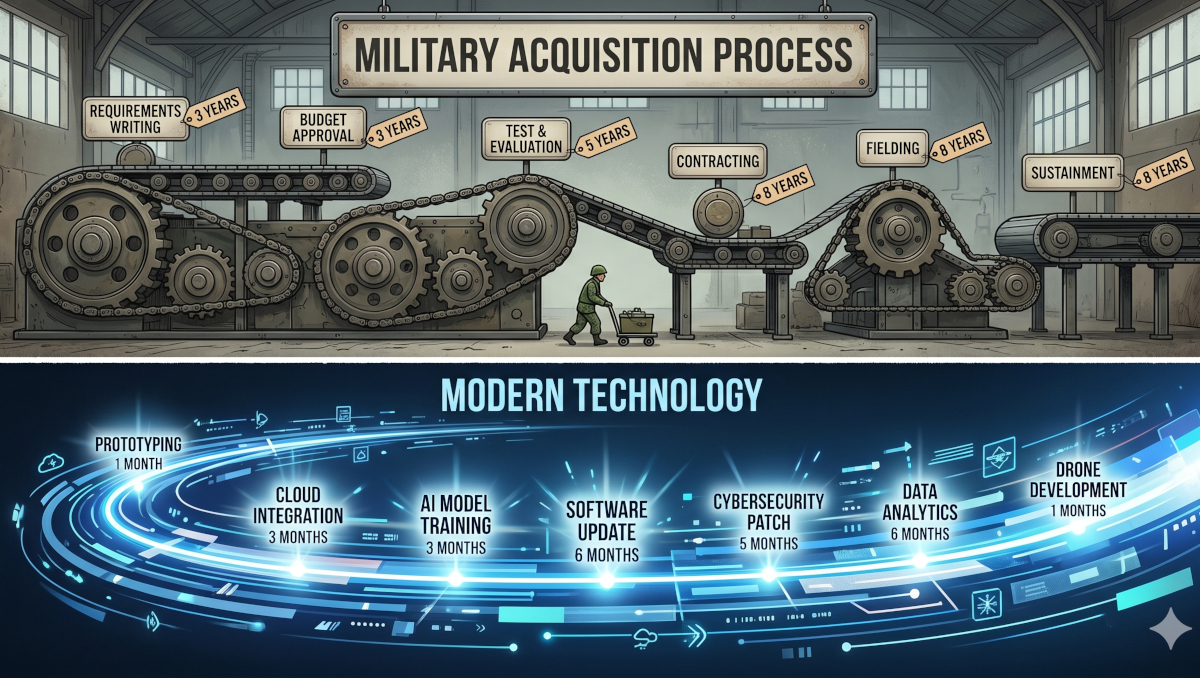
Integrating cutting-edge technology into military formations is less about the gadgets themselves and more about organizational agility. Host Tom Galvin sits down with a Carlisle Scholars Program research team—John Williams, Jeremy Jackson, and Antonio Ilario—to discuss how the military can better adopt disruptive technologies.
The team highlights that bureaucratic acquisition traditionally moves in years, while modern tech evolves in months. This friction leaves frontline operators innovating outside official channels while formal requirements play catch-up.
To bridge this gap, the researchers emphasize the need to incentivize frontline innovators, foster a culture of calculated risk, and utilize specialized hubs like the Pathway for Innovative Technology (PIT) to act as a clear “front door” for game-changing ideas.
The requirements process moves in years, while technology always moves in months.
Podcast: Download
Antonio Ilario is a colonel in the Italian Army with command and staff experience at tactical, operational, and strategic levels. He has deployed to Lebanon, Chad, Kosovo, and Afghanistan, where he served as a Signal Advisor to the Afghan National Army. Most recently, he was Executive Officer to the Commander of KFOR in Kosovo. He is a member of the AY26 Resident Course at the U.S. Army War College, an International Fellow and a member of the Carlisle Scholars Program.
Jeremy Jackson is a colonel in the U.S. Army Reserve, Adjutant General Corps. Following graduation from the War College he is heading to the 200th Military Police Command. He is a member of the AY26 Resident Course at the U.S. Army War College and a member of the Carlisle Scholars Program.
John M. Williams II is a lieutenant colonel and an Army Acquisition officer with 22 years of experience advancing modernization across combat tech integration, S&T leadership, CBRNE defense, and virtual training systems. He has led major programs for AFC, USARPAC, SOF, and the IC, and holds advanced degrees in leadership, biomedical engineering, and materials science. He is a member of the AY26 Resident Course at the U.S. Army War College and a member of the Carlisle Scholars Program.
Tom Galvin is Associate Professor of Resource Management in the Department of Command Leadership and Management (DCLM) as well as the leadership and management instructor for the Carlisle Scholars Program. at the United States Army War College. He is the author of the monograph Leading Change in Military Organizations and companion Experiential Activity Book.
The views expressed in this presentation are those of the speakers and do not necessarily reflect those of the U.S. Army War College, U.S. Army, or Department of War.
Photo Credit: Created by Gemini


If we are interested in reforming procurement; this, at the speed of relevance, then what might this look like, for example, as relates to the Russian military “information domain” threat described below:
“Abstract:
Russia’s March 2026 proposal to restrict foreign AI systems, including ChatGPT, Gemini, and Claude, on the grounds of protecting ‘traditional Russian spiritual and moral values’ has been largely treated as a regulatory story. This analysis argues it is not one. The proposal is the latest expression of a military doctrine documented in Russia’s own authoritative military publications, one that has treated the formation of values and collective identity as a primary security battlefield since at least 2014. Drawing on primary source material from Voennaya Misl’ (ENG: Military Thought), the Russian Defense Ministry’s flagship military journal, and tracing the doctrine’s origins to the Kremlin’s response to the 2011-2012 Bolotnaya protests, this piece argues that Russia’s ‘traditional values’ campaign, sovereign internet architecture, AI restrictions, and external information operations are not separate policy domains. Rather, they are a coherent two-directional architecture: hardening domestic cognitive space against external penetration while eroding the common identity substrate of adversary societies. Western FIMI analysis correctly identifies the visible effects of Russian information operations but systematically underweights the deeper target, which is the shared values framework that enables collective action. This piece reframes the analytical problem and identifies implications for practitioners assessing Russian behavior in the information domain.” (See the May 22, 2026, Small Wars Journal article “For Russia, AI and ‘Traditional Values’ are Part of the Same Security Logic” by Anna Varfolomeeva.)
In this regard, what is the “common identity substrate”/the “shared values framework” (a) of the West that has (b) forced/forged Putin’s military “information domain” response above?
Note: Obviously, this cannot be such things as “traditional spiritual and moral values” that the Russians and the West have in common and, thus, share (ex: as relates to Christianity?). These would not threaten Putin and, thus, could not be used by Putin against the West, to call us “an adversarial society.” Rather, and accordingly, we must look for Western “civil substrate” matters that are (a) common to the West but that are (b) distinctly different from Putin’s Russia and, thus, ARE threatening to him. As to such distinctly Western matters, consider the following:
“In the information age, a state of terror such as the one that Putin’s Russia has become, cannot countenance states of consent, especially next door. It is Ukraine’s constitutional order — with its independent (though still troubled) judicial system, freedom of the press, multiparty politics, largely legitimate elections, vibrant civil society, and general respect for human rights — that Putin cannot tolerate, lest it provide too tempting an example for democratic activists in his own country who have vehemently opposed him at great risk to their lives and to the public in general that shares so many ties to the people in Ukraine. The ‘peaceful coexistence’ of the Cold War is, in this respect, not acceptable to Putin.” (See the Real Security article “Putin’s Real Fear: Ukraine’s Constitutional Order” by Philip Bobbitt.)
Thus, as to the Russian MILITARY “information domain” threat/problem described above, what might be proposed — within our military information domain — that “reformed procurement — at the speed of relevance” — could get after now/right away”
“Modernization is no longer defined by how quickly an idea is conceived, but by how rapidly and effectively it is delivered to Soldiers in operational environments.” (See the March 9, 2026, U.S. Army Acquisition and Support Center (USAASC) article “Forging The Fast Lane: The Army Establishes The Pathway For Innovation And Technology.”
Questions:
a. Should the — massive and fundamental/the first magnitude — Russian military information domain effort, noted in my initial comment above, should this be considered as part of our/a Soldiers’ “operational environment?” (To wit: The Information/Cognitive Space: How information is disseminated, perceived, and acted upon by people?)
b. If so, then should the — massive and fundamental — Russian military information domain effort, noted in my initial comment above, should this be considered as one of the U.S. Army’s/the U.S. militaries’ most important and pressing “operational problems?”
c. If so, then should not a fully throated U.S. Army PIT (Pathway for Innovation and Technology) effort/approach have been applied, to this such operational problem, yesterday, and even more so today?
d. If so, then what does this such U.S. Army PIT (Pathway for Innovation and Technology) effort/approach — as to the information domain operational environment/the operational problem discussed above — what does this such U.S. Army PIT effort/approach look like today? In this regard, are their technological — and/or other — products that are in development — and/or that have already been developed; these, to address this such (first magnitude?) operational problem? If so, can we know what some of these such products might look like/what they might be?