
https://warroom.armywarcollege.edu/podcasts/reshaping-military-maintenance
On today’s high-tech battlefield, constant drone surveillance and long-range weapons, like those seen in Ukraine, mean that “safe” rear areas no longer exist. Right now, combat units are getting dangerously bogged down dragging broken equipment across huge distances because the current military maintenance system lacks a reliable middle tier to handle complex repairs.
To address this, Octavia Davis and Scott Pinkstaff join host Steve Trynosky to argue that the military must bring back a mobile, adaptable intermediate maintenance layer. Moving long-term repairs further back allows front-line mechanics to focus on quick battlefield diagnostics and instant fixes rather than getting stuck towing deadweight. It also requires a major cultural shift from simply swapping out broken parts to actually troubleshooting and repairing them on the ground.
Some terms and acronyms that popped up in this conversation:
UAS (Unmanned Aircraft Systems / Drones)
EW (Electronic Warfare)
NTC (National Training Center)
BSB (Brigade Support Battalion)
FSC (Forward Support Company)
UMCP (Unit Maintenance Collection Point)
BDAR / BDR (Battle Damage Assessment and Repair)
The reintroduction of an intermediate tier restores significant operational flexibility and the agility of the maneuver commanders.
Podcast: Download
Octavia Davis is a colonel in the U.S. Army and has had an exceptional Army Logistics career, most recently as “Goldminer 7” at NTC. She previously commanded the 3rd Cavalry Regimental Support Squadron and will assume command of the 1st Cavalry Division Sustainment Brigade after graduating from USAWC. Her broadening assignments include a RAND Fellowship and time at HQDA G-8. She is writing her SRP on revitalizing the Army’s Field Maintenance system for LSCO. She is a graduate of the AY26 Resident Course at the U.S. Army War College.
Scott Pinkstaff is a colonel and Logistician in the U.S. Army. He most recently served as Division G-4 for the 1st Cavalry Division. He previously commanded a BSB in the 11th Airborne Division and was SGS for the 1st TSC. Scott served a joint tour at TRANSCOM after completing ILE at the Naval War College. He is a member of the Ukraine IRP and has extensively analyzed sustainment and field maintenance developments on both sides of that conflict. As part of that effort, Scott recently co-authored a piece for AUSA with Dr. John Nagl, Transforming in Contact: The Army is Changing—Because It Must. He is a graduate of the AY26 Resident Course at the U.S. Army War College.
Stephen Trynosky is the John Parker Chair of Reserve Component Studies at the U.S. Army War College and earned his commission as a Medical Service Corps Officer from ROTC in 1998. He has held a diverse range of command and staff assignments in both the Regular Army and Army Reserve, to include, most recently, Senior Advisor, Professional Military Education, Office of the Secretary of War; and Commander, 993rd Medical Detachment (Veterinary Service Support). COL Trynosky holds both Juris Doctor and Master of Public Health degrees from the State University of New York at Buffalo, as well as a Master of Military Art and Science from the U.S. Army School of Advanced Military Studies and a BA in history from Saint Peter’s College. He is a graduate of the AY23 Resident Course at the U.S. Army War College.
The views expressed in this presentation are those of the speakers and do not necessarily reflect those of the U.S. Army War College, U.S. Army, or Department of War.
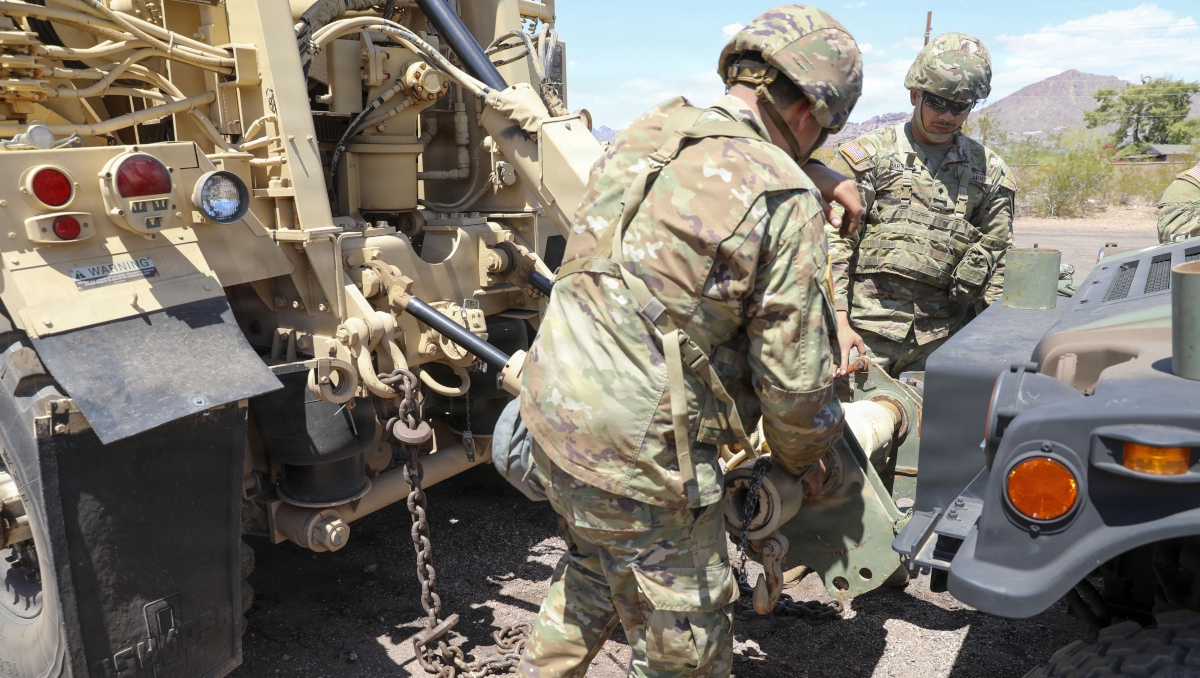
Photo Description: U.S. Army Spc. Jorge Martinez (right), Pvt. Roberto Michel, wheeled vehicle mechanics with 1348th Service Maintenance Company, prepare a Heavy Expanded Mobility Tactical Truck (HEMTT) to tow a high mobility multipurpose wheeled vehicle during vehicle recovery training at Papago Park Military Reservation, Phoenix, Ariz., May 2, 2026. The 1348th SMC battle damage assessment repair training lanes consisted of vehicle recovery, react to mounted contact, call for fire, and request a medivac for injured personnel in order to increase cohesion and unit combat readiness.
Photo Credit: Photo by U.S. Army Arizona National Guard Sgt.Thurman Snyder
Beginning at about the 22:10 point in this podcast, COL Pinkstaff speaking, midway into answering a question from COL Trynosky; a question that he, COL Trynosky, asks beginning at about the 20:55 point in this podcast:
” … If I think about MDO — Multi-Domain Operations — the Army’s current operating concept, it is about convergence, and how we layer effects in time and space, and I mean layer effects from space, to cyber, to EW, to long-range precession fires which are exquisite munitions; if I’m going to layer all these different things in time and space to set the conditions for that ground element to achieve that — but they are unable to because they have culminated prior to or do not have sufficient combat power, because our maintenance structure is such that I can’t regenerate it (combat power?) rapidly enough — then MDO: we will not be able to achieve what we have laid out there, because we have an unknown flaw in our doctrine … ” (Item in parenthesis above is mine.)