
What happens when you unleash the expertise of senior military students to fix complex bureaucratic processes? In a dynamic year of organizational reforms, the Vice Chief of Staff of the Army challenged a team of eight U.S. Army War College students to help improve how the military designs, builds, and resources its forces.
Jared Britz and Josh Eggar join host Bob Bradford to discuss how their integrated research project team designed a series of realistic tabletop exercises to stress-test new strategic planning and capability delivery processes. By simulating real-world scenarios, the students brought together heavy hitters from the Pentagon and operational commands to spot hidden friction points and organizational gaps before they became costly mistakes.
This student-led effort leveraged tools like large language models to flesh out their scenarios and provide decision-makers with a crucial external reality check on impending reforms, ensuring the military runs faster and more efficiently.
So we had force managers, we had acquisition officers, we had basic branch officers that have worked in the Pentagon, we had logisticians. So it was a group with a wide set of skills that really brought different perspectives to the project.
Podcast: Download
Jared Britz is a colonel and Functional Area Force Manager in the U.S. Army. An Armor Officer by background, he brings extensive operational experience to his current institutional roles in the Army. His institutional portfolio includes key modernization and requirements positions at HQDA G‑8, a fellowship at MITRE, and two nominative assignments with U.S. Army Cyber Command focused on force structure, capability development, and enterprise integration. Following graduation, he will lead the Requirements and Resources Division at U.S. Central Command. He is a graduate of the AY26 Resident Course at the U.S. Army War College.
Joshua Eggar is a lieutenant colonel in the U.S. Army. Commissioned as an Engineer Officer from the United States Merchant Marine Academy in 2001, he has served three combat deployments to Iraq and served with 1st Armored Division, 2nd Infantry Division, 101st Airborne Division, Army South, 1st Army, and the Corps of Engineers. His most recent assignment was as Military Construction Analyst in Headquarters, Department of the Army G-8. He is a graduate of the United States Army Command and General Staff College, and he holds a Master of Arts in Political Science from Kansas State University. He is a graduate of the AY26 Resident Course at the U.S. Army War College.
Bob Bradford is the Associate Professor of Defense and Joint Processes at the U.S. Army War College and is in his tenth year on the Carlisle faculty. He is the Director of the Enterprise Management Enrichment Specialization (EM), an enrichment specialization. Bob served 30 years as an officer in the U.S. Army, the last 20 as an operations research analyst supporting enterprise decisions.
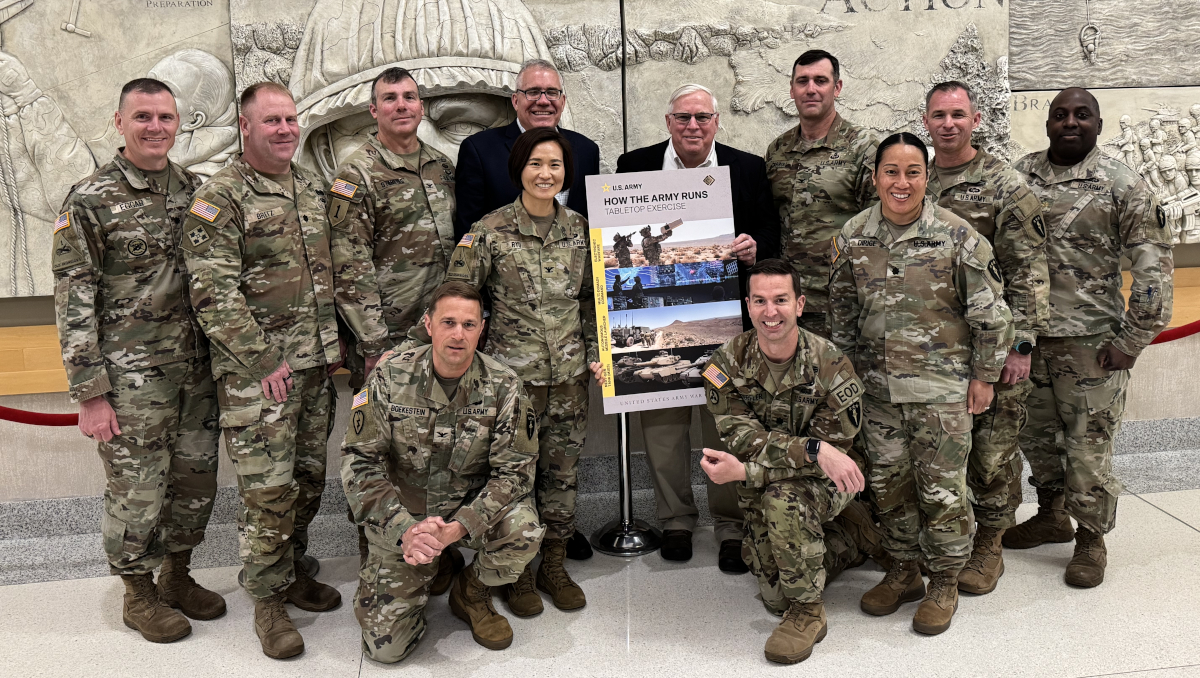
Photo Description: The integrated research project team (Back row L-R): LTC Josh Eggar, COL Jared Britz, COL James Starling, Professor Bob Bradford, Professor Lou Yuengert, COL Thomas Carroll, LTC Nate Costa LTC Kurt Reynolds; (Middle row L-R): COL Sun Ryu, LTC Desiree Dirige; (Kneeling L-R): COL Benjamin Boekestein, LTC Matthew Derfler. Photo includes students, faculty, and support staff and was taken in the Pentagon Conference Center on 9 April 2026 at the end of the TTX.
Photo Credit: Courtesy of Bob Bradford


If the primary aim of deterrence is to convince our adversaries that using force — to achieve their objectives — will fail, or will prove too costly for them even if they succeed,
And if we are successful in convincing our adversaries of this, then will not (have not) our adversaries logically move(ed) on — in an effort to become expert, and dominant, in obtaining and achieving their objectives via other ways and other means?
Given this such “real world scenario,” did the integrated research project team design their series of realistic tabletop exercises, and stress-test new strategic planning and capability delivery processes; this, with this such “win without fighting” concept/approach, of our adversaries, in the very forefront of their minds/from this exact such contemporary perspective?
(Thereby, being better/best able to spot, among other exceptionally important and critical things, hidden friction points, and organizational gaps, before they became costly mistakes?)
Possibly stated another way, “How Does the Army Run” — given the threat — the innovation — the adaptation — of our “win without fighting” adversaries today?
As, possibly, a way to see if these and other integrated research project teams, etc., have designed their “real world scenario” war games, realistic tabletop exercises, stress-tests, etc. — adequately — within the “win without fighting” concept/approach of our adversaries that I describe above;
As a possible way of doing this, might this be asking whether the war games, the tabletop exercises, the stress tests, etc., whether these take place — begin, are conducted within, and end — completely and exclusively within a PEACE-TIME environment — to wit: within the environment which our “win without fighting” opponents intend to operate, engage, win, achieve their objectives, etc.?
Note: If the war games, tabletop exercises, stress tests, etc. — using such things as multi-domain operations — if these occur in some simulated non-peace-time environment — such as “in time of war” and/or as in “periods leading up to war” scenarios — then, given the “win without fighting” approaches of our opponents — which occur in peace-time — might these such war games, tabletop exercises, stress tests, etc., be considered as being non-realistic, less-realistic and, accordingly, as being non or less useful?
Bottom Line:
Does “transformation” today — to include that which relates to multi-domain operations, etc. — do these such “transformations” acknowledge, accommodate and show adequate interest in and ability to “win” in (a) the peace-time environment, (b) within which, (c) our “win without fighting” adversaries intend to extensively operate?