
Editor’s Note: The authors of this article are a collaborative research team from the U.S. Army War College participating in the Artificial Intelligence Literacy for the Warfighter program, instructed by Dr. William Barry of the Center for Strategic Leadership and sponsored by NGC2 Director, BG Michael Kaloostian. Their Integrated Research Project examines how emerging artificial intelligence capabilities intersect with military decision‑making, operational design, and the future of command in large‑scale combat operations.
On a modern battlefield, sensors, digital systems and dispersed formations generate a torrent of information that commanders are expected to absorb, interpret and act on faster than any adversary.
The U.S. Army is facing a problem that grows larger every year: the amount of data flowing into command posts has outstripped the ability of humans to make sense of it. On a modern battlefield, sensors, digital systems and dispersed formations generate a torrent of information that commanders are expected to absorb, interpret and act on faster than any adversary. But officers across the force say the math no longer works. There is simply too much data and too little time.
The result is a widening gap between what the Army collects and what it can actually use. Staffs spend hours pulling information from disconnected systems, formatting it for briefings and reconciling conflicting inputs. The Military Decision‑Making Process, once designed to help staffs think clearly, has become a labor‑intensive struggle to keep up with the flow of information. Under time pressure, staff officers are often forced to make arbitrary decisions about which data to include, exclude, or simplify, creating the same kind of cognitive bottlenecks described by Stephen Gerras and Andrew Hill and in their “Lucy in the Chocolate Factory” analysis of decision overload. Commanders often receive products that look polished, but reflect these compromises rather than the comprehensive understanding required for sound judgment.
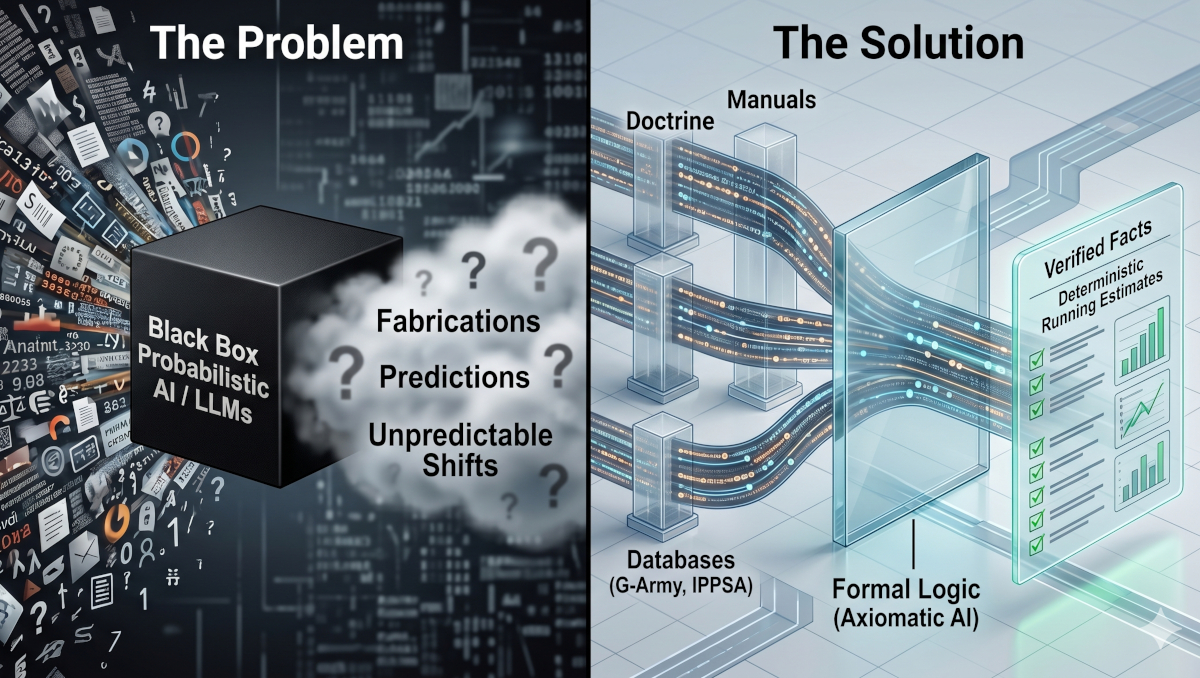
The Army has turned to artificial intelligence for help, but many of the tools under consideration rely on large language models (LLMs) that generate text by predicting the next likely word. These models can write fluently, and most high‑end LLMs now provide sources, but they cannot guarantee accuracy or reliably distinguish between authoritative doctrine and commentary. They rely on internal knowledge drawn from their training data, and many high‑end LLMs—especially those operating in web‑enabled interfaces such as ChatGPT or Gemini—use a controlling layer or query classifiers, similar to the LLM control‑plane architectures described by Avril Shafran et al., to determine when internal knowledge is insufficient and external data must be queried. Although some systems can supplement their training data with near‑real‑time information, their underlying models still evolve unpredictably through user interaction, making them unreliable for planning or real‑time operations where accuracy is essential.
Research conducted through an integrated research project at the U.S. Army War College identifies the need for a different approach. The resulting concept, termed “axiomatic artificial intelligence,” is designed to provide commanders with a decision‑support system that retrieves facts rather than predictions. The concept of axiomatic AI combines formal logic with trusted data sources to create verifiable, transparent, and reliable systems, moving away from the “black box” approaches common in probabilistic models. Instead of generating answers from patterns in training data and the internet, the system would pull information directly from trusted data sources such as doctrine, technical manuals, logistics databases (e.g., G‑Army, IPPS‑A, Ark.ai), and the unit’s common operating and intelligence pictures.
This approach aligns with the Army’s own requirements for accuracy, traceability, and timeliness. It also mirrors the structure of the warfighting functions, allowing each staff section to work from the same authoritative data. By reducing the time spent hunting for information, the system could accelerate planning, improve running estimates, and help commanders make decisions with greater confidence.
The idea emerged from the Army War College’s Artificial Intelligence Literacy for the Warfighter project, which examines how emerging technologies intersect with military decision‑making. The project began by assessing why current AI tools fall short and found that large language models, despite their popularity, are fundamentally misaligned with military needs.
Large language models illustrate why a different approach is needed. In testing, even the most advanced models produced fabrications, blended doctrinal terms with commentary, and generated confident‑sounding but incorrect descriptions of Army processes; problems rooted in the way LLMs predict text rather than retrieve verified information. These systems excel at producing narratives, but their outputs can shift unpredictably as the underlying model evolves. This makes them poorly suited for military planning, where precision, repeatability, and authoritative sourcing are essential. Axiomatic intelligence takes the opposite approach: instead of predicting answers, it draws exclusively from trusted data sources and applies formal logic to produce transparent, verifiable outputs (e.g., running estimates, planning products, and warfighting products). By grounding decisions in authoritative information rather than statistical inference, axiomatic systems avoid the confusion and misinformation that LLMs can introduce and provide a more reliable foundation for command and control.
The project also looked at the Army’s data architecture and found that much of the information needed for planning is locked behind layers of policy, security controls and system boundaries. Accessing it requires navigating what amounts to “moats and drawbridges” —a patchwork of authorities and permissions that slows down even the most experienced staffs. Any decision‑support system must operate inside the Army’s trusted data environment, not outside it.
As development progresses, NGC2’s interest in linking AI-enabled planning to accessible data sources will become a priority.
A breakthrough came when the project identified a company already working within that environment. Onebrief, a defense technology firm providing an AI-powered collaborative software platform designed to support military planning and operations, was asked to fill a planning gap within the Army’s Next Generation Command and Control (NGC2). Its involvement and willingness to participate opens a path to test axiomatic intelligence without months of bureaucratic negotiation and demonstrates that the concept is technically feasible. NGC2 is experimenting with architectures that could support this kind of system, but is currently focused on targeting rather than planning. As development progresses, NGC2’s interest in linking AI-enabled planning to accessible data sources will become a priority.
Axiomatic intelligence could help close the planning gap by providing a deterministic backbone for decision support. Instead of relying on probabilistic models, the system would retrieve facts from authoritative sources and present them in a format that supports rapid analysis. Commanders would still make the decisions, but they would do so with clearer and more reliable information.
The concept also has implications for the philosophy of warfighting. By accelerating decision cycles, axiomatic intelligence could help commanders outpace adversaries in complex, multi‑domain environments. It could strengthen human‑machine teaming by allowing machines to handle data retrieval while humans apply judgment. And by improving accuracy and accountability, it could reinforce ethical standards in the use of force. The goal is not automation. Commanders do not need a machine to make decisions for them; they need a system that delivers the right information at the right time, without the noise.
The approach could be especially valuable for reserve component leaders, who often have limited time to train complex planning processes. By providing consistent, real‑time data, axiomatic intelligence could help part‑time staffs operate at the speed and quality of more experienced units.
Still, the concept faces hurdles. Integrating with existing systems will require cooperation across multiple organizations, and the Army will need to prioritize access to trusted data sources. There is a clear need for sustained investment in experimentation, partnerships with industry, and continued study of how deterministic systems can support command in large‑scale combat operations.
The work is part of a broader effort to help the Army adapt to an era defined by data saturation. As the volume of information continues to grow, the services must find ways to turn that data into understanding, and to do so faster than any adversary. Axiomatic intelligence offers a path to reclaiming the art of command in a world where information overload has become one of the greatest threats to decision‑making.
The project’s findings come at a time when the Army is reexamining how it fights, how it organizes, and how it prepares for future conflicts. Senior leaders have warned that the next war will be fought at a pace and scale unlike anything the service has experienced in decades. In that environment, the ability to make timely, informed decisions could determine the outcome of entire campaigns.
For now, the AI Literacy for the Warfighter project continues to refine the concept and explore ways to test it in operational settings. They believe the Army has an opportunity to build a system that strengthens the commander’s judgment and doing so is essential for maintaining decision advantage in the years ahead.
The work underscores a simple but urgent truth: in modern war, information is abundant, but understanding is scarce. Axiomatic intelligence aims to bridge that gap, giving commanders the clarity they need to fight and win in an increasingly complex world.
Timothy A. Price is a colonel and an Army Infantry Officer in the U.S. Army. His career includes leadership in light and motorized infantry formations and service with Special Operations Forces. COL Price is the incoming commander of the 2nd Cavalry Regiment, serving as the 84th Colonel of the Regiment. He is a member of the AY26 Resident Course at the U.S. Army War College.
Jason A. Murray is a colonel and a Field Artillery officer in the U.S. Army. He currently serves as Director of the Joint Advisory Group–Somalia with Joint Special Operations Task Force–Somalia. His career includes all artillery platforms, advisory, joint, and special operations assignments across multiple theaters globally. He is a member of the AY26 Resident Course at the U.S. Army War College.
Dallen R. Arny is a colonel in the U.S. Army and a Military Intelligence officer with 51 months of overseas and combat deployments. Commissioned through the Virginia Military Institute, his key assignments include the 2nd Ranger Battalion, 160th SOAR, and 11th Airborne Division. Following the U.S. Army War College, the father of seven will join the National Geospatial-Intelligence Agency. He is a member of the AY26 Resident Course at the U.S. Army War College.
Daniel K. Bourke is a lieutenant colonel in the U.S. Army. He spent the past eight years serving across the Pacific, most recently commanding 3rd Battalion, 196th Infantry Brigade in Guam. He is now preparing to transition to U.S. Army Cadet Command at Fort Knox. He is a member of the AY26 Resident Course at the U.S. Army War College.
Zachary T. Ramsey is a lieutenant colonel and an an AGR Armor Officer in the U.S. Army. His past few years of service include time in Europe, the Middle East, and his most recent assignment was as the Commander of Task Force Defender in Korea where he commanded a multinational unit in comprised of U.S. and Korean Soldiers. His next assignment will be serving as an Exercise Planner at INDOPACOM. He is a member of the AY26 Resident Course at the U.S. Army War College.
Jonathan D. McElhaney is the director of the U.S. Customs and Border Protection Survivor Advocacy, a workforce-oriented initiative of U.S. CBP closely aligned with military Casualty Assistance programs. He is also a U.S. Army Reserve Lieutenant Colonel, commanding the 783d Military Police Battalion in Germany. He is a member of the AY26 Resident Course at the U.S. Army War College.
William “Billy” Barry, PhD, is Professor of Emerging Technology at the U.S. Army War College and creator and professor of the AI Literacy and Lethality for the Warfighter program. Dr. Barry’s research is at the intersection of warfighting, emerging technology and psychology. He is recognized for pioneering human-AI collaboration and persistent memory systems and his Hybrid Axiomatic/ Bayesian Intelligence systems. He is internationally recognized as the first professor worldwide to have an AI Android teaching assistant at the University level and was featured on an award nominated documentary at the Sundance Film Festival.
The views expressed in this article are those of the authors and do not necessarily reflect those of the U.S. Army War College, the U.S. Army, or the Department of War.
Photo Credit: Created by Gemini


An interesting topic for essays, research papers, etc.?:
a. Based on his ideas, etc., which of the present AI’s would Clausewitz have preferred to use and why?
b. Based on his ideas, etc., which of the present AI’s would Sun Tzu have prefer to use and why?
c. Based on his ideas, etc., what AI — not presently available — would Clausewitz want us to develop?
d. Based on his ideas, etc., what AI — not presently available — would Sun Tzu want us to develop?
(Same questions for other — relevant and important — military professionals and their ideas, etc.)
Example answer — from “AI Overview:”
“Why Clausewitz Rejects Axiomatic AI:
An axiomatic system operates on absolute mathematical truths, rigid logic, and fixed premises. Clausewitz famously argued that such doctrines based on past historical events are dangerous if used as universal models. He believed war resists fixed mathematical formulas because of three overriding factors: The Fog of War: Data is always incomplete, contradictory, and constantly shifting. Friction: The reality of the battlefield never matches the neat plans drawn up in theory. Human Will: War is a clash of human passions, morale, and cunning, which cannot be reduced to deterministic axioms.
Why Clausewitz Would Prefer an LLM:
Clausewitz would favor an LLM because it operates on probabilistic reasoning, patterns, and natural language. Rather than trying to ‘solve’ war like an equation, an LLM mimics the intuitive human judgment that Clausewitz called Coup d’Oeil (the ability to make rapid, accurate decisions in the dark) and Genius (the ability to rise above strict rules when the situation demands it).”
Im not conviced LLM will provide the correct environment as it will be missing the contextualisation real time as well as the adaptation required to match the human brain logic that can be mimic with fuzzy logic.
I wonder who first introduced OneBrief to USAWC?
Interesting perspective on the difference between predictive AI and fact-based decision support. The focus on transparency and trusted data sources makes this a thought-provoking read. Thanks for sharing.