
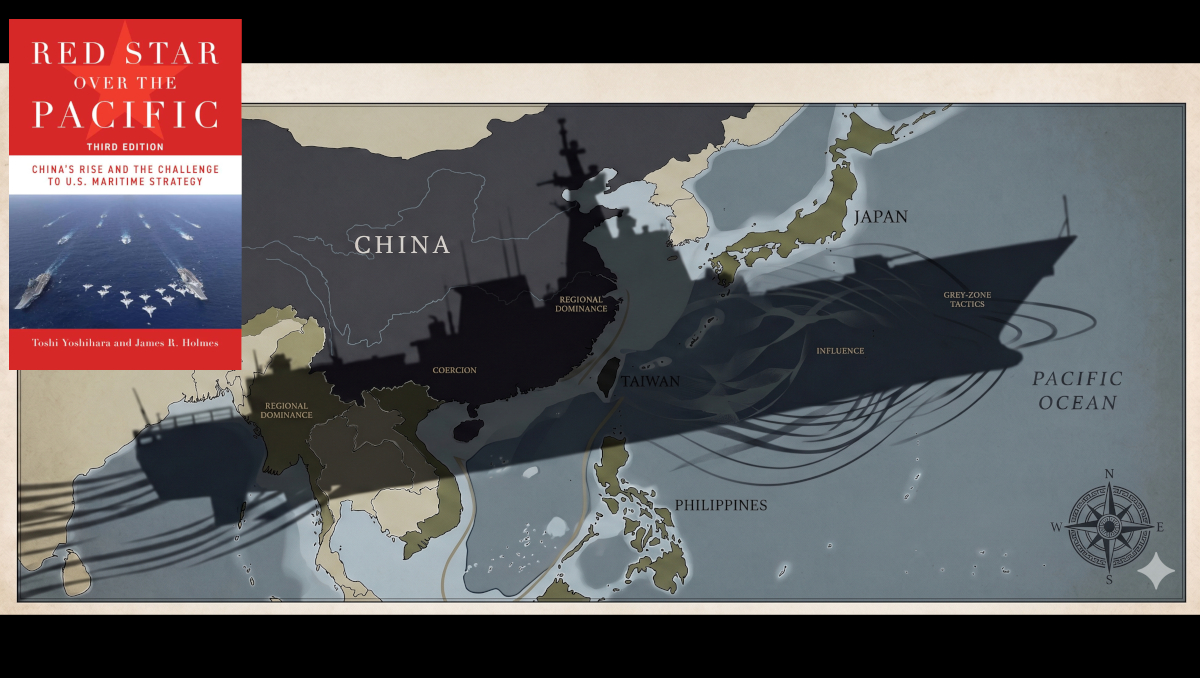
How has China transformed into a dominant naval power, and what strategic choices must the U.S. make to protect its interests in the Pacific? Toshi Yoshihara and James Holmes join Ron Granieri to discuss the third edition of Red Star Over the Pacific, which answers those very questions. The authors explain how Beijing synthesizes Western and Eastern strategic ideas to expand its maritime reach. Crucially, the conversation moves beyond simple threat assessments to explore how the United States should respond. Yoshihara and Holmes emphasize that the U.S. must maintain its unrivaled regional alliances, exploit competitive undersea strengths, and enforce strict strategic discipline to counter China’s growing naval challenge.
China’s quest for control in the maritime domain is driven both by a weird combination of both confidence and insecurity.
Podcast: Download
James Holmes, PhD, is the inaugural holder of the J.C. Wiley Chair of Maritime Strategy at the U.S. Naval War College and previously served on the faculty of the University of Georgia School of Public and International Affairs. A former U.S. Navy surface warfare officer, he also earned a PhD from the Fletcher School of Law and Diplomacy, Tufts University.
Toshi Yoshihara, PhD, is a senior fellow at the Center for Strategic and Budgetary Assessments. Previously, he was the inaugural John A. van Beuren Chair of Asia-Pacific Studies and a professor of strategy at the U.S. Naval War College. He holds a PhD from the Fletcher School of Law and Diplomacy, Tufts University.
Ron Granieri is Professor of History and the Chair of the Department of National Security and Strategy at the U.S. Army War College and the Editor of A BETTER PEACE.
The views expressed in this presentation are those of the speakers and do not necessarily reflect those of the U.S. Army War College, U.S. Army, or Department of War.
Photo Credit: Created by Gemini




If we were to see China’s efforts, in the maritime environment, more from the perspective of an insurgency — as the below Center for International Maritime Security (CIMSEC) articles do — then, from that such perspective, might Sun Tzu and Mao be considered as being more influential than, for example, Mahan?:
“Hunter Stires …
China is trying to overturn this system of international law and the freedom of the seas, and replace it with its own sino-centric, hierarchical, authoritarian vision of what they refer to as ‘blue national soil.’ As the phrase implies, this means the oceans can be claimed as if they are land. You basically fence off a patch of ocean and stick a flag in it, regardless of where that happens to be. In doing so, they seek to disenfranchise their less powerful neighbors from their rightful exclusive economic zones under international law.
There are generally two ways these two legal orders can contend with each other.
One is the conventional approach, which is where each side gets out their military, they have a fight, and then after the fight is over, the winner sequentially imposes their laws on the civilian population. That’s the sequential method, we generally refer to that as conventional war.
Now for the other option. If one side either doesn’t think they would win that fight, or if they just choose not to engage in that kind of conventional force-on-force confrontation, they have the option to decline battle with the defender of the established order and instead, seek to impose their own laws on a civilian population. That is what you are seeing China do. And we have a term for that kind of campaign design: it’s an insurgency.”
(See the CIMSEC article “Defending Global Order Against China’s Maritime Insurgency — Part 1, March 25, 2026, by Dan White and Hunter Stires)
“Hunter Stires:
I think you got it exactly. China’s approach here is inherently continentalist. Its maritime strategy involves land-centric thinking. I would argue that’s actually a weakness of their strategy, because you can’t permanently occupy the ocean.
Think about the nature of China’s strategy here, as an insurgency, in the context of China’s strategic canon. Sun Tzu and Mao are the two most important figures. Of course, there are others, but these are the two principal writers that everybody reads. They’re both land commanders.
Sun Tzu advocates the indirect approach of winning without fighting or winning before the other side gets a chance to form ranks. Mao is the most successful insurgent in history. As a result, insurgent strategies permeate everything that China does. Insurgency is fundamental to the DNA of the Chinese Communist Party, because that’s how they came to power.”
(See the article “Defending Global Order Against China’s Maritime Insurgency – Part 2, April 1, 2026, by Dan White and Hunter Stires)
From the perspective of White and Stires, thus, the answer here would be for America, and its allies, to do something like “counterinsurgency?”
Question No. One:
a. If — based on recent U.S. actions — the governments and people of the Indo-Pacific come to see the United States in much the same “bulling” terms as they have come to see China’s re: its (China’s) “bullying actions:
“Tariffs: The One-Two Punch:
While halting the majority of USAID and State Department foreign assistance programs will no doubt have a larger tangible effect on the everyday lives of Pacific Islanders, the “Liberation Day” tariff announcements also caused shock and confusion in a region that has long looked to the United States as global economic leader with which countries sought closer trade ties. The high rates on these small and often struggling economies—where in some islands over 25 percent of the population lives below the poverty line (see Figure 4)—appeared disconnected with both reality and common sense. The United States has a trade surplus with all but two of the Pacific Islands—Fiji ($208 million trade deficit) and Tuvalu ($168,000 trade deficit), the latter of which has a population of around 11,000—and yet almost none escaped liberation day unscathed. …
Implications for U.S. National Security
“As a Republican professional staff member of the U.S. House Committee on Armed Services said at an April 2025 committee hearing on military posture and national security challenges in the Indo-Pacific, ‘we have built very strong relationships…and this has been the greatest thing that has really frustrated China, it’s now surrounded by a group of nations that don’t want to be bullied by China, so they’re looking to us for support . . . and now we are trying to out bully China . . . and show [our partners] that we can punch them just as hard as China can punch them.’ ”
(See the July 22, 2025 Center for Strategic and International Studies [CSIS] paper “Shifting Tides: The National Security Implications of the United States’ Pacific Drawdown” by Charles Edel, Kathryn Paik, and John Augé)
b. Then, from that exact such “bullying” perspective, might this tend to undermine the U.S. Navy’s “Maritime Counterinsurgency Project,” discussed immediately below:
“The U.S. Navy’s Maritime Counterinsurgency Project aims to shine a bright light on the People’s Republic of China’s illegal activities to harass, intimidate, and bully other states in the South China Sea region into accepting China’s excessive claims to the entire South China Sea. The project will also develop strategic, operational, tactical, and force structure recommendations on how to thwart China’s illegal efforts.”
(See the U.S. Naval Institutes’ “Maritime COIN: Countering China’s Gray-Zone Tactics Starts with a Simple but Challenging Premise” page.)
Question No. 2:
Might Xi’s recent recommendation of — and the U.S.’s recent acceptance of — a three year period of “constructive strategic stability,” might this be seen from the perspective of Xi wanting to give the governments and peoples of the Indo-Pacific more time to reflect on these (and other?) U.S. “bulling” matters?
Additional overall question, based on my comment immediately above:
If governments and peoples throughout the world come to see the United States as being much more like, rather than much different from, the other great and/or rising powers of the world,
Then, in these such circumstances, will not the governments and peoples of the world, therefore, accordingly and quite naturally, be logically forced to reconsider their strategic alignments, partnerships, arrangements, relationships, etc., with the United States — and with the other great and/or rising powers of the world — this, based exact on this such “new U.S. national identity” sea change?
If so, then does it not behoove China (Russia, etc.) — to buy and provide space and time (say three years — see “constructive strategic stability” in the last paragraph of my second comment above) — within which — these such “national security considerations/reconsiderations” — based on “the new national identity of the United States” — can take place?