
EDITOR’S NOTE: Twenty-five years ago, the September 11 attacks altered the trajectory of the nation and the lives of countless Americans. As we pause this week to remember and honor the victims, their families, and the first responders who sacrificed everything, we must also reflect on the strategic origins and legacy of that day.
This week, WAR ROOM is re-releasing three selections from our archives that examine what we have learned since about Al-Qaeda’s capabilities, how the experience of 9/11 marked a profound shift in presidential decision-making and the systemic missteps in Afghanistan. We offer this retrospective not just to understand the last quarter-century of conflict, but to honor those we lost by rigorously examining the national security apparatus built in their memory.
Twelve years ago last week, on May 2, 2011, the U.S. military conducted a raid in Abbottabad, Pakistan that killed Usama bin Laden. Once the mission was accomplished, the SEAL team conducted sensitive site exploitation and gathered up and returned with all of the materials and equipment they discovered in the compound. Nelly Lahoud and her team sorted through some 97,000 files and 6,000 pages of declassified documents, all in Arabic, to discover the truth about bin Laden and the al-Qaeda network. She’s in the studio to discuss her book, The Bin Laden Papers: How the Abbottabad Raid Revealed the Truth about Al-Qaeda, Its Leader and His Family with host John Nagl. The information gleaned from this incredible undertaking paints a picture of a man and a network that, after the 9/11 attack, were confined, restrained and not very successful.
I think for about a decade he appeared to be somebody who was too powerful, when in reality he was not. We find that in the letters between himself and his associates, we find them struggling, whether it’s finances or the inability to move, there were many impediments…After the collapse of the Taliban regime, the letters make it very clear that al-Qaeda was shattered by then and al-Qaeda’s ability to mount international terrorism came to a halt.
Podcast: Download
Subscribe: Apple Podcasts | Spotify | Amazon Music | Android | Pandora | iHeartRadio | Podchaser | Podcast Index | TuneIn | Deezer | RSS | Subscribe to A Better Peace: The War Room Podcast
Nelly Lahoud is Associate Professor in the Department of National Security and Strategy at the U.S. Army War College. Dr. Lahoud’s research has focused on the evolution and ideology of al-Qaeda (AQ) and the “Islamic State” (ISIS/ISIL). Her latest book, The Bin Laden Papers: How the Abbottabad Raid Revealed the Truth about Al-Qaeda, Its Leader and His Family, was published with Yale University Press (2022) and featured on CBS’s 60 Minutes. Lahoud is fluent in Arabic and French.
John Nagl is an Associate Professor of Warfighting Studies at the U.S. Army War College. He is the author of Learning to Eat Soup with a Knife: Counterinsurgency Lessons from Malaya and Vietnam.
The views expressed in this presentation are those of the speakers and do not necessarily reflect those of the U.S. Army War College, U.S. Army, or Department of War.
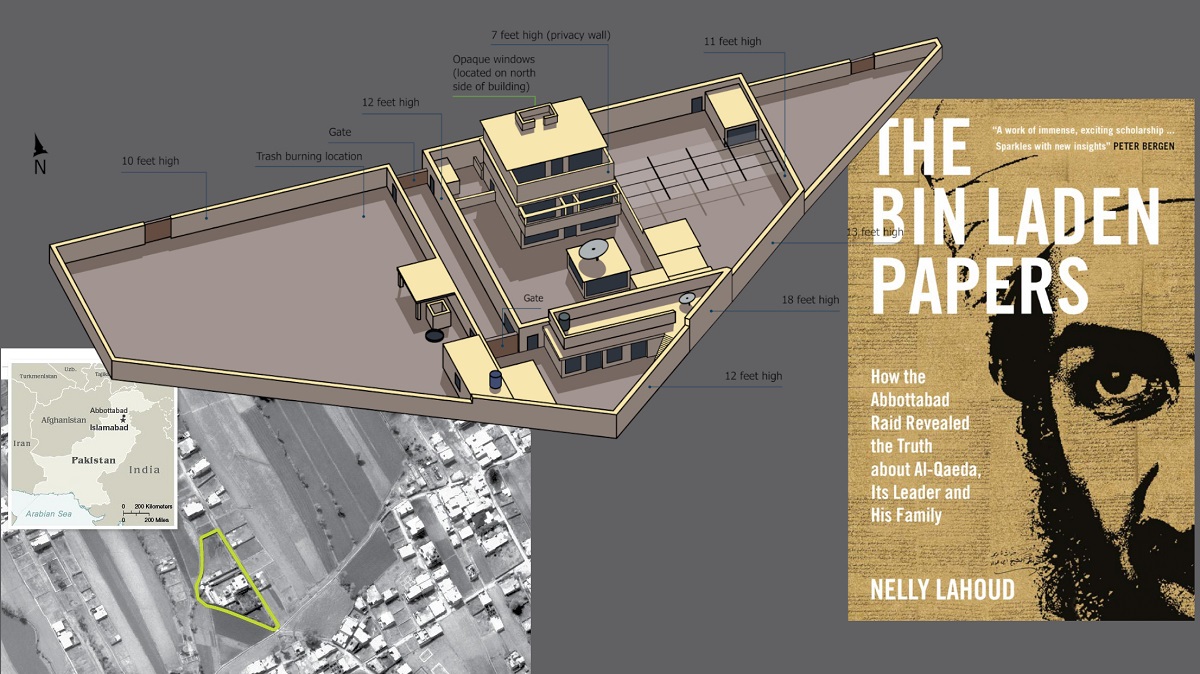
Photo Description: Aerial view and diagram of Usama bin Laden’s secret compound and the location of his death in Abbottabad, Pakistan
Photo Credit: Compound diagram by U.S. Defense Intelligence Age
From the written introduction to our article above:
“Twenty-five years ago, the September 11 attacks altered the trajectory of the nation and the lives of countless Americans. As we pause this week to remember and honor the victims, their families, and the first responders who sacrificed everything, we must also reflect on the strategic origins and legacy of that day.”
As to “strategic origins” — and “legacy of that day, — I suggest we must consider these from a much broader perspective than simply 9/11, and, thus, (a) more from the perspective of the “transformative” efforts of great powers, both yesterday and more recently, and (b) more from the perspective of the “resistance” to great power transformation efforts (abroad and here at home), both yesterday and more recently. In this regard, consider the following:
a. Great power “transformative” efforts abroad (for example, see “pioneers of civilization” below), and resistance thereto, before the Cold War:
“Small wars are a heritage of extended empire, a certain epilogue to encroachments into lands beyond the confines of existing civilization and this has been so from the early ages to the present time. The great nation which seeks expansion in remote quarters of the globe must accept the consequences. Small wars dog the footsteps of the pioneers of civilization in the regions afar off.” (See Chapter II: “Causes of Small Wars … “, in C.E. Callwell’s “Small Wars: …”)
b. Great power “transformative” efforts abroad, and resistance thereto, during the Cold War:
“The United States and Russia face each other not only as two great powers which in traditional ways compete for advantage. They also face each other as the fountain heads of two hostile and incompatible ideologies, systems of government and ways of life, each trying to expand the reach of its respective political values and institutions and to prevent the expansion of the other.” (See beginning at the bottom of Page 428 of Hans Morgenthau’s “To Intervene or Not to Intervene.”)
c. Great power “transformative” efforts abroad, and resistance thereto (9/11?), after the Cold War:
“Since the 1990s the focus of American international security policy has been focused on creating conditions for extending zones of security and prosperity to other states under the theory that ‘political as well as economic globalization would make the world safer — and more profitable — for the United States.’ Consequently, the United States saw expansion, rather than retraction, of American military presence around the world.” (See the 2016 edition of the book “Exporting Security: International Engagement, Security Cooperation, and the Changing Face of the US Military,” by U.S. Naval War College Professor Derek S. Reveron; therein, see the bottom of Page 2 of the Introduction chapter.)
d. Great power “transformative” efforts at home, and resistance thereto, more recently:
“Liberal democratic societies have, in the past few decades, undergone a series of revolutionary changes in their social and political life, which are not to the taste of all their citizens. For many of those, who might be called social conservatives, Russia has become a more agreeable society, at least in principle, than those they live in. Communist Westerners used to speak of the Soviet Union as the pioneer society of a brighter future for all. Now, the rightwing nationalists of Europe and North America admire Russia and its leader for cleaving to the past.” (See the March 21st, 2018, “The American Interest” article entitled “The Reality of Russian Soft Power,” by John Lloyd and Daria Litinova.)
Conclusion:
Thus, as to such things as 9/11 “strategic origins” — and “legacy of that day” — these, I suggest, must be seen within a broader context; this being, for example, (a) the “transformative” efforts of great powers throughout history and (b) the “resistance” to the transformative efforts of great powers, also throughout history?
(In this regard, note that such things as “restoring one’s nation and/or civilization to greatness,” this is a “resistance to transformation” tactic, ploy, etc., of entities, throughout history, both here at home and there abroad?)
But, in fact and ultimately, did Osama bin Laden “win?”:
From the Friday, Sep 11, 2026 TIME article “How 9/11 Helped Shape Our Politics Today,” by Faisal Devji:
“A sacrificial, if not nihilistic, movement whose iconic figure was the suicide bomber, Al-Qaeda had little interest in conquest and government. One of its major objectives was to provoke Western states into attacking their own democracies, in a kind of auto-immune response to terrorism, in which the effort to defend the political body corroded it from within. In that particular sense, bin Laden was perversely successful in dragging America and its allies into expensive wars and weakening their liberal norms as they chose widespread use of emergency powers, surveillance, indefinite detention, torture, and rendition. The war also brought suspicion of Muslims, hostility toward immigration, civilizational rhetoric, and border militarization from the political margins to the center of Western public discourse.
America’s preoccupation with the war on terror did squander its unipolar decade. It wasn’t a coincidence that the rise of China—and the China shock—came a few years after the Great Recession of 2008 and a decade after the 9/11 attacks. The cultural and political landscape of Europe and America today—characterized by polarization, populism, and a pervasive distrust of institutions—can be understood, at least in part, as the legacy of the response to the 9/11 attacks by Al-Qaeda. By this measure, my assertion would be that bin Laden won the war on terror much as he had predicted he would.”