
EDITOR’S NOTE: Twenty-five years ago, the September 11 attacks altered the trajectory of the nation and the lives of countless Americans. As we pause this week to remember and honor the victims, their families, and the first responders who sacrificed everything, we must also reflect on the strategic origins and legacy of that day.
This week, WAR ROOM is re-releasing three selections from our archives that examine what we have learned since about Al-Qaeda’s capabilities, how the experience of 9/11 marked a profound shift in presidential decision-making and the systemic missteps in Afghanistan. We offer this retrospective not just to understand the last quarter-century of conflict, but to honor those we lost by rigorously examining the national security apparatus built in their memory.
This week in the studio, editor-in-chief JP Clark sits down with Bryan Groves to discuss his new book,When Presidents Fight the Last War: The Oval Office, Sunk Costs, and Wartime Decision-Making Since Vietnam. Groves, a U.S. Army strategist and accomplished academic, focuses on the difficult mid-conflict course-correction decisions made by presidents. His research uses an interdisciplinary approach to analyze how the enormous “sunk costs” of war—lives, time, and treasure—tempt presidents to escalate or “double down” on a conflict rather than cut their losses. Groves’s analysis of five cases—including the Iraq surge and the Desert Storm endgame—reveals a major historical pivot: while pre-9/11 decisions were often guided by the fear of repeating the Vietnam “quagmire,” post-9/11 decisions were also driven by the powerful lesson of preventing another domestic catastrophe.
So from Vietnam to 9/11, avoiding a quagmire, “no more Vietnams” as the bumper sticker was the lesson… 9/11 was different than previous catastrophes… and was able to replace the Vietnam lessons as dominant because it was a uniquely American tragedy.
Podcast: Download
Subscribe: Apple Podcasts | Spotify | Amazon Music | Android | Pandora | iHeartRadio | Podchaser | Podcast Index | TuneIn | Deezer | RSS | Subscribe to A Better Peace: The War Room Podcast
Bryan Groves is a colonel in the U.S. Army and an accomplished academic. He is a paratrooper, Green Beret, and a strategist. He has been the Initiatives Group Chief for the Commanding General of the U.S. Army Forces Command, the Chief of the Strategy Division on the Joint Staff where he led the effort to write the National Military Strategy, and then as the Army representative for the current National Defense Strategy that will be shortly released. As an academic, he has taught at West Point, was a term member of the Council on Foreign Relations, and has a BS from West Point, an MA from Yale, and an MPP and PhD from Duke University. He is the author of When Presidents Fight the Last War: The Oval Office, Sunk Costs, and Wartime Decision-Making Since Vietnam (University of Kentucky Press, 2025)
JP Clark is an associate professor of military strategy teaching in the Basic Strategic Art Program. He served in the army for twenty-six years as an armor officer and strategist. He holds a Ph.D. and M.A. in history from Duke University, an M.S.S. from the Army War College, and a B.S. in Russian and German from West Point. He is the author of Preparing for War: The Emergence of the Modern U.S. Army, 1815-1917 (Harvard, 2017). He is currently working on a history of U.S. military strategy in the Pacific from 1898 to 1941 that is under contract with the University Press of Kansas. He is the 3rd Editor-in-Chief of War Room.
The views expressed in this presentation are those of the speakers and do not necessarily reflect those of the U.S. Army War College, U.S. Army, or Department of War.
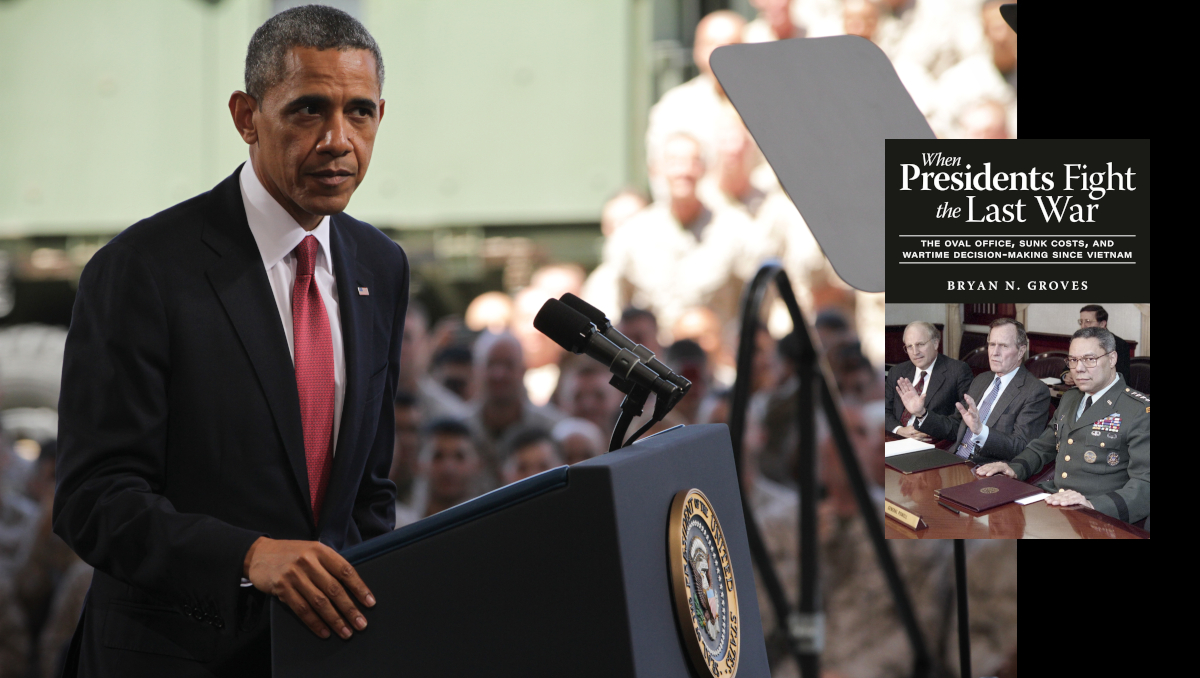
Photo Description: President Barack Obama speaks to a crowd of Marines, sailors and family members aboard Camp Pendleton, Aug. 7, 2013. President Obama visited the base to thank the Marines and sailors for their commitment to the mission in Iraq and Afghanistan and commended 1st Marine Division for being the most ready when the nation is least ready.
Photo Credit: Sgt. Michael Cifuentes
If we were to look at these matters from the perspective that I provide at the previous podcast in this series, to wit: at the “Unmasking the Boogeyman: The Bin Laden Papers (Re-Release)” podcast, then how might my such perspective — if at all — effect our thinking as to this matters presented in the above podcast, to wit: at the “Beyond Vietnam: Sunk Costs in Presidential Strategy (Re-Release)” podcast?
In this regard, and for example, if we were to consider such things as “sunk costs” (a) more from the perspective of various great power’s efforts to “transform” their own, and/or other, states, societies and/or civilizations, and (b) more from the perspective of the “resistance” that such great powers run in to; this, as relates to their such specific “transformative” efforts — then, from that such perspective, might we be better able to understand — and be better able to discuss — such things as “sunk cost” — and “presidential decision making” (etc.) — relating to same?
As to the matters that I present above, and at the previous podcast, (a) re: 9/11, (b) can this be considered as a “sunk cost;” this, as relates to our post-Cold War agenda, and related efforts, to transform outlying states and societies more along modern western political, economic, social and/or value lines?
“For the past three decades, as the United States stood at the pinnacle of global power, U.S. leaders framed their foreign policy around a single question: What should the United States seek to achieve in the world? Buoyed by their victory in the Cold War and freed of powerful adversaries abroad, successive U.S. administrations forged an ambitious agenda: spreading liberalism and Western influence around the world, integrating China into the global economy, and transforming the politics of the Middle East.” (From “Foreign Affairs” [Mar/Apr 2020 issue], in the article therein by Jennifer Lind and Daryl G. Press entitled “Reality Check: American Power in an Age of Constraints.”)
If so (re: 9/11, this, indeed, can be considered as a “sunk cost;” this, as relates to our post-Cold War agenda, and related efforts, to transform outlying states and societies more along modern western political, economic, social and/or value lines), then, from that such perspective, should we not see what occurs, for a number of years thereafter, as “escalation” — and indeed as “doubling down” — on our effort to transform outlying states and societies more along modern western political, economic, social and/or value lines? (This, rather than [a] abandoning our such “transformative” agenda and related efforts and [b] cutting our losses accordingly?)
(Note how acknowledging that our political objective was to transform outlying states and societies more along modern western political, economic, social and/or value lines; note how this allows us to better [a] frame these matters and [b] address, ask and answer questions relating to same?)