
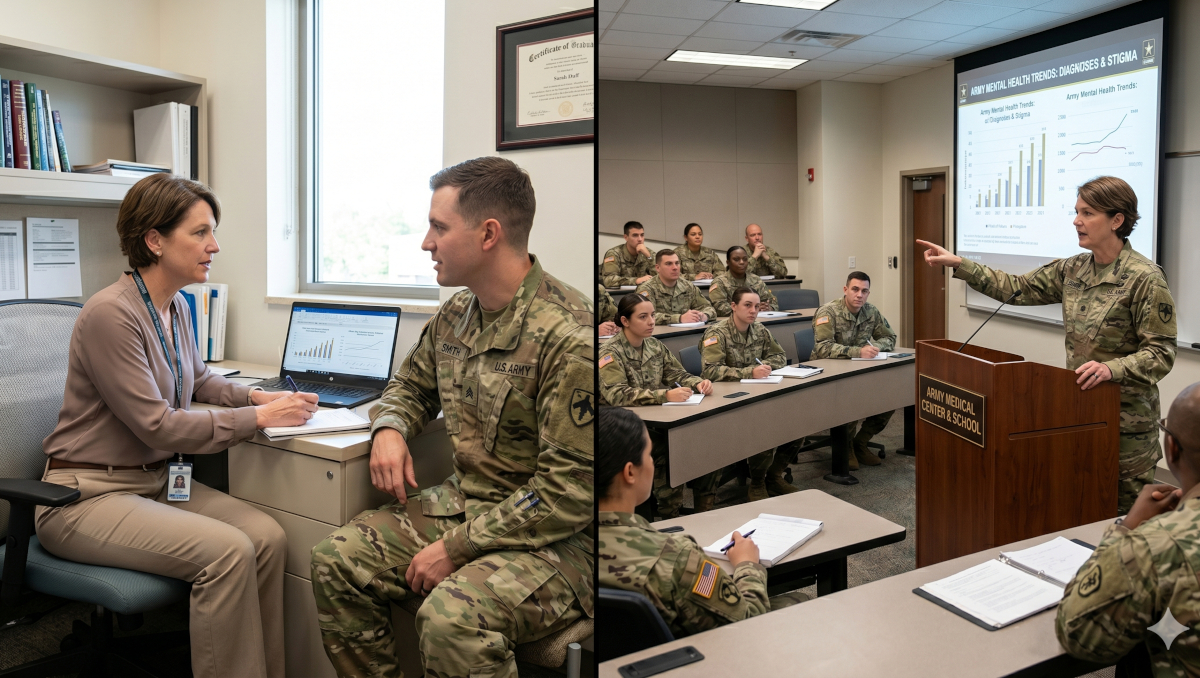
I have routinely met soldiers who presented for a routine medical concern or command-directed evaluation, and quietly disclose months of worsening sleep, irritability, and emotional withdrawal they normalized as “just part of the job.”
Unlike the visible impacts of war—physical injury and battlefield trauma—the invisible wounds of anxiety, depression, and post-traumatic stress are more difficult to conceptualize but are just as critical to mission readiness. As a clinician with nearly two decades of experience and a military instructor molding the next generation of military medical leaders in mental health, I have observed directly how the Army’s mental health field has evolved over the past decade. Previously, mental health struggles gave the appearance of being rare or episodic. However, now we are seeing more persistent patterns that demand systemic adaptation across policy, culture, and clinical practice.
Clinically, this shift becomes visible long before it appears in serious incident reports or on baseball cards during high-risk meetings. I have routinely met soldiers who presented for a routine medical concern or command-directed evaluation, and quietly disclose months of worsening sleep, irritability, and emotional withdrawal they normalized as “just part of the job.” Many discussed delaying care, not because they doubted treatment, but because they feared being marked as weak or unreliable to leadership. Those conversations, repeated across formations and training environments, give urgency to the trends described in this article.
Three noticeable trends have emerged. First, mental health diagnoses among soldiers are skyrocketing in recent years. Second, there remains a clear gap between the need for care and help-seeking behaviors, which are frequently rooted in stigma and structural challenges. Third, suicide risk is still a primary indicator of psychological strain across Army formations. Examined together, these emphasize the urgency of modifying how the Army understands, prevents, and treats mental health.
Viewing these patterns both from the clinic and the classroom reveals a disconnect between what emerging leaders are taught about behavioral health and what soldiers experience in real operational environments. Leaders may receive training on recognizing indicators of crisis yet remain less prepared to identify the slower erosion of functioning that precedes most clinical presentations.
Rising Diagnoses: A Call to Notice the Invisible Epidemic
From 2019 to 2023, rates of mental health diagnoses among active-duty service members increased significantly, by nearly 40 percent. According to the Department of Defense’s (DoD) Armed Forces Health Surveillance Division, 541,672 active component members received at least one mental health diagnosis over these five years. Most diagnoses were adjustment disorders, anxiety, depressive disorders, and post-traumatic stress disorder (PTSD). This statistical surge, tracked in systems like the Behavioral Health Data Portal (BHDP), likely reflects a combination of factors. While it certainly points to a growing psychological burden on the force, it is also a positive indicator of better training for providers and leaders in identifying early symptoms, improved reporting efforts, and a reduction in stigma that encourages more soldiers to come forward.
Clinically, this is not surprising but should be sobering. Anxiety disorders and PTSD, which nearly doubled over the five years, have long been recognized as common consequences of combat exposure and military life stressors. Given the stressors of repeated relocations, family separation, chaotic training calendars, and cumulative career demands, this trend is predictable. Of note, these trends span the pre-pandemic, pandemic, and post-pandemic periods, reflecting sustained increases rather than a short-term disruption.
For Army leaders and clinicians, rising diagnoses are not simply statistics. These are real people—real soldiers whose functioning, relationships, careers, and lives may be at risk without timely and adequate care.
Stigma and Structural Barriers: Why Soldiers Still Delay Care
Despite increasing recognition of mental health issues, soldiers continue to delay or avoid seeking help. Stigma—both perceived and internalized—is a barrier. Research shows service members often fear negative judgment from peers and superiors. They worry that accessing mental health care will harm their careers or reputation, especially in units where toughness and self-reliance are core values.
Studies in military populations show a consistent pattern: higher levels of public and personal stigma correlate with lower likelihood of pursuing professional mental help. This fear is not unfounded, particularly regarding substance use issues. Army policy, such as that outlined in the Substance Use Disorder Clinical Care (SUDCC) Operations Manual, distinguishes between self–referral and the type of care received. A soldier who self-refers for an alcohol-related concern may still be placed in mandatory, command-notified treatment if their condition is deemed a risk to safety or mission, creating a structural ambiguity that fuels hesitation. Even when services are available, concerns pertaining to confidentiality and career impact can dissuade soldiers from engaging with mental health professionals. In my own clinical work, soldiers have described the internal conflict of wanting help yet fearing career repercussions. This emotional cost regularly wins out.
Policies like the Brandon Act, which allows service members to self-initiate a confidential mental health evaluation, are designed to lower these barriers. While this represents considerable progress, its effectiveness ultimately depends on local education and leadership reinforcement.
Beyond stigma, structural barriers persist. Access to mental health providers, particularly psychiatrists, varies across installation and community contexts. Mental health care utilization is strongly influenced by the availability of military psychiatrists within a reasonable travel distance; where capacity is higher, soldiers are more likely to use services, whereas shortages predict missed opportunities for early intervention. I have witnessed many soldiers who have built up the resolve to seek help change their minds and “about face” back out the door when they learn about the approximate wait time to see the embedded prescribers for their units.
It is not enough to encourage soldiers to seek help; the system must ensure that quality mental health care is both available and perceived as safe to access.
Suicide as a Warning of Mental Health Strain Across the Force
Perhaps the most distressing and visible trend in Army mental health is suicide. Suicide remains the chief indicator of unmet mental health needs and psychological distress across military populations. Recent DoD reports show that the number of U.S. military suicides increased in 2023, with 523 service members taking their own lives…increasing from 493 in 2022. Active component suicide rates have increased, particularly among young, enlisted members.
A key challenge for the Army is to differentiate between the pre-existing vulnerabilities that new recruits bring with them from society and the unique psychological strains imposed by military service itself.
It is important to note that this trend is not occurring in a vacuum; it mirrors a broader, troubling rise in depression and suicide among young adults in the civilian world. A key challenge for the army is to differentiate between the pre-existing vulnerabilities that new recruits bring with them from society and the unique psychological strains imposed by military service itself.
Those military-specific strains are significant and directly linked to suicide risk. The cumulative stress of demanding training, financial pressures, relationship breakdowns, adverse performance evaluations, and operational stress can create a state of psychological strain that makes a soldier far more vulnerable. Soldiers with untreated depression are significantly more likely to die by suicide; one analysis reported these soldiers were 11 times more likely to die by suicide than their peers without a depressive diagnosis. Anxiety disorders, including PTSD, were also associated with elevated suicide risk.
Suicide prevention calls for vigilance across domains: screening, assessment, safety planning, access to lethal means counseling, and robust follow-up care after high-risk encounters. Suicide is not simply a mental health issue—it is a direct threat to readiness and a critical leadership responsibility.
The Role of Culture, Education, and Leadership
When I teach military health professionals and allies, as well as brief commanders, I focus on mental health as both an individual clinical concern and an organizational issue. Mission readiness depends not only on physical fitness but also on emotional and psychological resilience. Culture and leadership shape whether soldiers feel safe to acknowledge stress and pursue care.
The army’s shift toward the Embedded Behavioral Health (EBH) model, a core component of the Behavioral Health System of Care (BHSOC), is designed to formally integrate providers with operational units. These initiatives, alongside programs like Ask Care Escort – Suicide Intervention (ACE-SI) and supporting resilience initiatives that integrate mental wellness into daily life, indicate a critical shift: mental health is not an afterthought but a core component of holistic soldiering.
In practice, this focuses on the importance of equipping leaders to recognize indicators of distress and intervene proactively. Leaders do not need to be subject matter experts in clinical therapy to support their teams; they need to recognize when a soldier is struggling, communicate without censure, and facilitate access to professional help. Early engagement prevents crises.
That said, mental health education cannot magically resolve manpower deficits for qualified providers or structural gaps in care access. Resilience training does not fully immunize soldiers against traumas inherent in military service. However, it can shift viewing mental health from a stigmatized vulnerability to a readiness tool.
This analysis is intentionally limited to trends observed within active-duty army clinical and training settings. It does not attempt to represent the whole behavioral health experience of reserve components or military families. Additional research is needed to understand how these patterns translate across the broader military environment.
Army Mental Health Going Forward: A Call for Action
The trends unfolding in army mental health are not fleeting; they reflect deep structural and cultural dynamics that demand intentional, evidence-based responses. Rising diagnoses indicate more soldiers are reaching the threshold for clinical significance, yet stigma and access barriers continue to delay utilization, even as suicide rates remain stubbornly high.
To move forward, the army must expand past traditional reactive care models toward integrated mental health embedded in primary care, operational units, and leader development. This requires “creating enduring direct support relationships between individual BH providers and battalion (BN) level leadership teams,” a foundational goal of the EBH model. To achieve this, the army must consolidate its efforts around a clear set of recommendations:
First, fully resource and expand integrated care models like EBH, ensuring mental health providers are a familiar and trusted presence within battalions. Second, reform policies that create structural barriers to care, particularly by clarifying the confidentiality rules around substance use treatment to remove the ambiguity that discourages help-seeking. Third, leadership at every level must champion a culture where seeking mental health support is framed as an act of strength and responsibility. This requires consistent messaging from senior leaders that mental health care exists to protect careers, backed by actionable policies protecting confidentiality. The next generation of providers must be trained not only in diagnosis and treatment but in cultural competency, trauma-informed care, and military leadership engagement. Finally, the army must continue to invest in research that distinguishes between broader societal trends and military-specific stressors, allowing for more targeted prevention strategies.
The army’s future readiness depends not only on its ability to treat psychological injury but also on its willingness to anticipate risk, reform systems that delay care, and build a professional culture where every leader is a steward of total soldier readiness. In addressing these trends, the army has an opportunity to fortify resilience and strengthen our most critical asset—our people.
Sarah Duff is a captain and an Army Behavioral Health Officer, clinician, and instructor in the U.S. Army. Her experience spans clinical, operational, and training environments, with a focus on suicide prevention, trauma-informed care, and command consultation. She previously served the military as a General Schedule (GS) provider prior to putting on the uniform. CPT Duff served two terms with the 1st Armored Division as an Embedded Behavioral Health Officer and currently serves at the Medical Center of Excellence as the Military Training Branch Team Lead and as an instructor, developing and delivering mental health content for military healthcare professionals, leaders, and allies.
The views expressed in this article are those of the author and do not necessarily reflect those of the U.S. Army War College, the U.S. Army, or the Department of War.
Photo Credit: Created by Gemini

What role might proper manning (“peopling?”) — to wit: having the proper number of able, capable, qualified, trained and motivated personnel — as relates to the mission(s) — play in — quickly and massively — improving the mental health (and thus the readiness and the viability) of the force?
From this such perspective, could not and should not improper/inadequate manning — in truth — be consider as a/the principal “root cause” of all the negative trends discussed in our article above?
Note: If improper/inadequate manning could and should be considered as the true “root cause” of everything being discussed in our article above, then the Army’s future readiness:
a. WILL NOT depend on our “ability to treat psychological injury (caused by inadequate manning) and also on our willingness to anticipate risk, reform systems that delay care, and build a professional culture where every leader is a steward of total soldier readiness.” But, rather,
b. WILL depend on our ability to provide proper and adequate manning of the force — as relates to our demands on and requirements of same.
Note: This is, obviously, an exaggeration, but:
If we were to (a) decrease the workload of today’s soldiers by half or (b) increase, by half, the number of soldiers assigned to today’s workload or (c) increase, by half, the amount of pay, allowances, etc., offered to today’s soldiers,
Then, as to any one of these such changes, should we expect to see — rather massively and rather immediately — a significantly positive improvement; this, in today’s “trends in military health?”
(If so, then inadequate/improper manning might, indeed, be the “cause;” this, as relates to today’s — negative — trends in military health “effect?”)
As to my comment immediately above, not “trends in military health” but, rather, “trends in military mental health.” (Although, trends in overall military health; this, also, might apply?)
Military mental health improvement would come when MH providers are part of the force structure from top to bottom. AKA being placed and with seats at the table just as the Chaplain Corps is at all the levels of the military structure and that would include in all compos. Active, Reserve and National Guard, all deserve the access to care and the providers should have a voice at all levels to advise of trends and considerations throughout the life cycle of a unit. If I had my way, I would have either a green suited behavioral health provider or a civilian behavior health provider at all armories full time and open up provision of services at such locations to all currently serving service members so that access to care is not a burden and already at an established location.