
Editor’s Note: This is our 500th episode. Thank you for being part of this journey, we wouldn’t be here without you. Your loyalty and engagement have turned a project into a community. Here’s to the next 500 episodes.
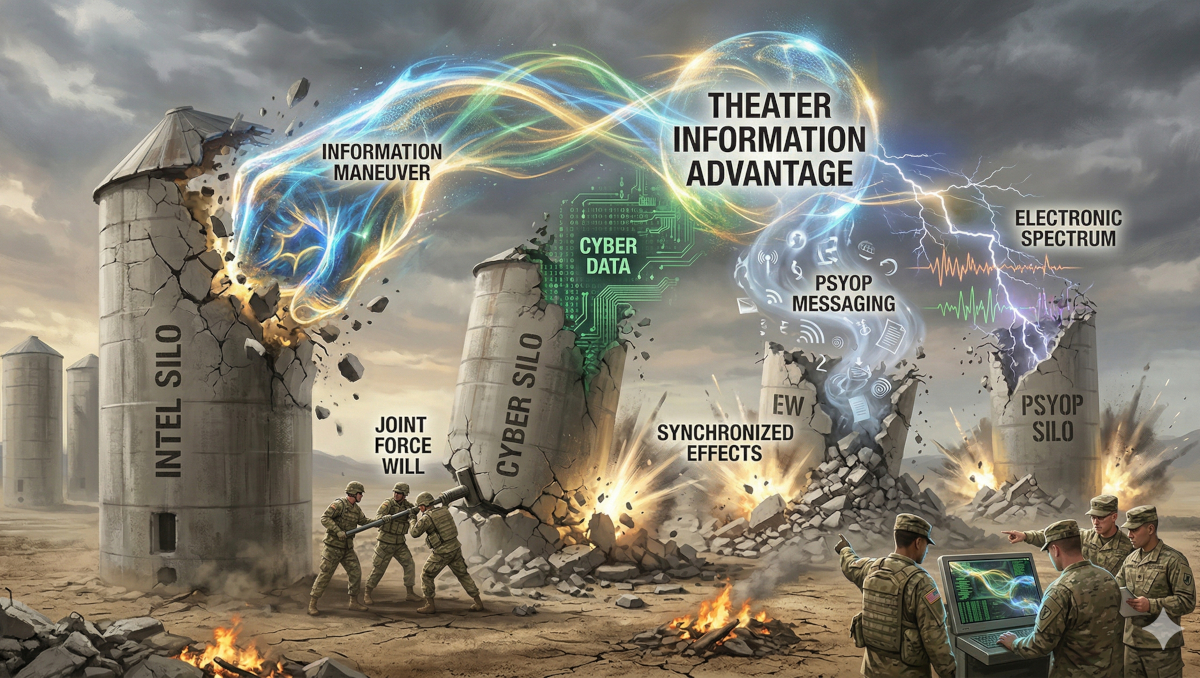
Modern warfare transcends tactical victories; it targets the adversary’s “will.” Sean Heidgerken joins host Tom Spahr to discuss the Army’s newest capability: Theater Information Advantage Detachments, or TIADs. These specialized units integrate experts in cyber, intelligence, psychological operations, public affairs, electronic warfare, civil affairs, and information operations to influence foreign actors and protect friendly information systems. Heidgerken, the commander of the 1st TIAD in the Indo-Pacific, explains that these organizations break traditional military silos by organizing into cross-functional teams. Whether exposing corruption through media or leveraging emerging AI to sense the environment, the TIAD mission is to ensure the Joint Force maintains an advantage in the gray zone of competition.
The operations, whether it be psychological operations, electronic warfare, or cyber, have been siloed in those sub-staff sections… which inherently builds a lack of synchronization and coordination across those activities.
Podcast: Download
Subscribe: Apple Podcasts | Spotify | Amazon Music | Android | Pandora | iHeartRadio | Podchaser | Podcast Index | TuneIn | Deezer | RSS | Subscribe to A Better Peace: The War Room Podcast
Sean Heidgerken is a colonel and an Information Operations Officer who has served over 30 years in the U.S. Army. He has deployed to Operation Iraqi Freedom four times, supported Operation Inherent Resolve in Iraq and Syria, supported the evacuation from Afghanistan in 2021, and conducted operations to support Ukraine during the Russian invasion in 2022, as well as operations against the Houthis in Yemen in 2023, and most recently in Operation Midnight Hammer against Iranian nuclear sites in June 2025. He is the commander of the 1st Theater Information Advantage Detachment (TIAD) in the Indo-Pacific theater.
Thomas W. Spahr is the DeSerio Chair of Strategic and Theater Intelligence at the U.S. Army War College. He is a retired colonel in the U.S. Army and holds a Ph.D. in History from The Ohio State University. He teaches courses at the Army War College on Military Campaigning and Intelligence.
The views expressed in this presentation are those of the speakers and do not necessarily reflect those of the U.S. Army War College, U.S. Army, or Department of War.
Photo Credit: Generated by Gemini

The matter that I would like COL Heidgerken to get after and discuss, this is the matter that finds (a) the U.S./the West, post-the Cold War, seeking to alter the ways of life, the ways of governance, the values, etc., of both our own states and societies and those of the rest of the world; these, more along more “liberal”/more market-friendly political, economic, social and/or value lines. And that finds (b) certain leaders and population groups in these such states and societies (to include in our own states and societies) fighting back; this, to prevent these such existentially threatening transformations from occurring — and/or to reverse such existentially threatening transformations which have already occurred.
It is from THIS such perspective, I suggest, that we must discuss such things as “overcoming the adversaries’ will;” adversaries who, via our such post-Cold War transformational attempts, came to realize that they were in grave and indeed existential danger; this, of losing (or of having already lost) the degree of power, influence, control, prestige, privilege, status, security, etc., that is/was theirs; this, before the U.S./the West’s such post-Cold War transformational “push.”
Herein, I suggest that you can see the contempory efforts being made by China, Russia, Iran, N. Korea, etc., etc., etc., today — and even being made by certain leaders and population groups here within the U.S./the West itself today — you can see these such efforts EXACTLY from the “resistance to transformation” — and/or from the “reversal to transformation” [due to the threat of or actuality of loss of power, influence, control, prestige, privilege, status, security, etc.] that I present above.
It is from THIS such perspective, I suggest, that we must discuss how to cause these such diverse (but otherwise potentially cooperative!!!) leaders and populations to “give up.”
At about the 09:00 point in this podcast, COL Heidgerken seems to make an argument different from mine; herein, suggesting that it is China, Russia, Iran, the Islamists, etc. — and not the U.S./the West — who are the post-Cold War “change agents,” and that it is the U.S./the West who is fighting to maintain the status quo.
(Ironically, however, at about the 10:30 point in this podcast, he seems to support this such argument using [see my initial comment above] classic “liberal”/”market-friendly” terms, such as “liberal international order,” “goods and services” and “global trade” and suggesting that “economic growth” is what people desire more than anything else.)
But is this true (post-the Cold War, China, Russia, Iran, etc., have been/are the world’s principal “change agents”) — or has COL Heidgerken gotten it wrong here — this, given such things as the (truthful?) observation made by Robert Egnell below?:
“Robert Egnell: Analysts like to talk about ‘indirect approaches’ or ‘limited interventions’, but the question is ‘approaches to what?’ What are we trying to achieve? What is our understanding of the end-state? In a recent article published in Joint Forces Quarterly, I sought to challenge the contemporary understanding of counterinsurgency by arguing that the term itself may lead us to faulty assumptions about nature of the problem, what it is we are trying to do, and how best to achieve it. When we label something a counterinsurgency campaign, it introduces certain assumptions from the past and from the contemporary era about the nature of the conflict. One problem is that counterinsurgency is by its nature conservative, or status-quo oriented – it is about preserving existing political systems, law and order. And that is not what we have been doing in Iraq and Afghanistan. Instead, we have been the revolutionary actors, the ones instigating revolutionary societal changes. Can we still call it counterinsurgency, when we are pushing for so much change?” (From the 2013 Small Wars Journal article “Learning From Today’s Crisis of Counterinsurgency” by Octavian Manea: An interview with Dr. David H. Ucko and Dr. Robert Egnell.”)
Suggestion — Based on the Above:
Truthfully, and credibly, the U.S./the West would not seem to be able to make the claim that, post-the Cold War, it was not/is not the world’s principal “change agent.” And, relatedly, the U.S./the West would — truthfully, credibly — also not seem to be able to make the claim that the current worldwide/both here at home and there abroad “resistance to change”/”reversal of change” phenomenon, that we are witnessing throughout the world today, this is not related, most directly and most exclusively, to the more “liberal”/the more “market-friendly” “change” efforts made by the U.S./the West post-the Cold War.
(Thus, once again, and from this such [truthful and credible?] perspective — and using such things as “information and intelligence” — how do we get our diverse “resisting unwanted-threatening change”/”reversing unwanted-threatening change” adversaries to “give up?”)
From the very beginning of our podcast above — Dr. Spahr speaking here:
“The Joint Force can win tactical fights during armed conflicts, but translating those victories into strategic results requires psychological effects. The enemy is not defeated until they believe they are defeated. And this hinges on their perceptions, attitudes, and beliefs.”
From that such perspective, let us ask the following questions:
Question No. 1: In consideration of the U.S./the West’s post-Cold War goal, to transform the states and societies the world (to include our own) more along more-“liberal”/more market-friendly political, economic, social and/or value lines; as to that such U.S/Western post-Cold War goal, do we believe that China, Russia, Iran, N. Korea, the Islamists, etc. — and even certain leaders and population groups here within the U.S./the West itself— do we believe that ANY of these such diverse entities believe that they have been “defeated? (“Being defeated” here meaning [a] to have their states and societies transformed more along more “liberal”/more market-friendly political, economic, social and values lines; this [b] causing many of those in-charge — who owe their degree of power, influence, control, prestige, privilege, status, security, etc., more to non-market/less-market forces — to lose this such derived power, influence, control, etc.)
The answer here — as to all these such diverse entities believing that they had been so “defeated” — this would seem to be a resounding “NO !”
Question No. 2: How do we believe that China, Russa, Iran, N. Korea, the Islamists, etc. — and even certain leaders and population groups here within the the U.S./the West today — how do we believe that these such diverse entities defeated the U.S./the West instead. (“Defeat” here meaning [a] to prevent the U.S./the West from transforming their states and societies more along more “liberal”/more market-friendly political, economic, social and value lines — and/or to reverse this such process — thereby, [b] ensuring that those in-charge — or those desiring to be in-charge — will be able to retain — or attain — the degree of power, influence, control, privilege, prestige, status, security, etc., that they currently enjoy — or seek to enjoy.
The answer here would seem to be by ALL of these such entities (a) appealing to such things as these such countries/civilizations/societies” “traditional values,” and by (b) pointing out that, post-the Cold War, same were under clear attack by the U.S./the West.
Thought — Based on the Above:
Obviously, this is not the first time in history in which the U.S./the West has sought to transform states and societies of the world (including our own) more along more “liberal”/more market-friendly political, economic, social and value lines. Likewise, obviously, this is not the first time in history in which entities, threatened by same — and appealing to such things as “traditional values” — stood hard against the U.S./the West; this, as to our such enduring goal. What, then, does history tell us; this, as to how the U.S./the West was able to defeat our adversaries in these such earlier contest times? And, accordingly, what does history tell us, as to how the U.S./the West, in those such earlier instances, caused our adversaries to “give up”/to acknowledge defeat?
In certain of my comments above, I have suggested that the U.S./the West has attempted to transform the states and societies of the world (to include our own states and societies); these, more along more liberal/more market-friendly lines. And, of late, has been defeated as to this such effort (and has admitted same and “moved on” accordingly?). In support of this such contention, consider the Cold War, the post-Cold War and the Trump era matters that I present below:
a. First, from the Cold War era, from Hans Morgenthau’s “To Intervene or Not to Intervene:”
“The United States and the Soviet Union face each other not only as two great power which in traditional ways compete for advantage. They also face each other as the fountain heads of two hostile and incompatible ideologies, systems of government and ways of life, each trying to expand the reach of its respective political values and institutions and to prevent the expansion of the other. Thus the Cold War has not only been a conflict between two world powers but also a contest between two secular religions. And like the religious wars of the seventeenth century, the war between communism and democracy does not respect national boundaries. It finds enemies and allies in all countries, opposing the one and supporting the other regardless of the niceties of international law. Here is the dynamic force which had led the two superpowers to intervene all over the globe, sometimes surreptitiously, sometimes openly, sometimes with the accepted methods of diplomatic pressure and propaganda, and sometimes the the frowned-upon instruments of covert subversion and open force.”
b. Next, from the post-Cold War era, consider the following from Dr. Jennifer Lind’s “Foreign Affairs” (Mar/Apr 2017 edition) article “Asia’s Other Revisionist Power: Why U.S. Grand Strategy Unnerves China:”
“Since the end of World War II, the United States has pursued a strategy aimed at overturning the status quo by spreading liberalism, free markets, and U.S. influence around the globe. … the United States’ posture stokes fear in Beijing and beyond. … But at its heart, U.S. grand strategy seeks to spread liberalism and U.S. influence. The goal, in other words, is not preservation but transformation. … The United States has pursued this transformational grand strategy all over the world. … In each of these regions, U.S. diplomatic, economic, and military policies are aimed not at preserving but at transforming the status quo. …”
c. Last, from the Trump era, consider the following:
“We are also realistic and understand that the American way of life cannot be imposed upon others, nor is it the inevitable culmination of progress.” (See Page 4 of the Trump 2017 National Security Strategy — midway down the second column.)
“We do not expect diverse countries to share the same cultures, traditions, or even systems of government. But we do expect all nations to uphold these two core sovereign duties: to respect the interests of their own people and the rights of every other sovereign nation. This is the beautiful vision of this institution, and this is foundation for cooperation and success.” (See about the 15th paragraph of the White House transcript of the Trump 2017 speech to the United Nations General Assembly.)
“Strong, sovereign nations let diverse countries with different values, different cultures, and different dreams not just coexist, but work side by side on the basis of mutual respect.” (See about the 16th paragraph of the White House transcript of the Trump 2017 speech to the United Nations General Assembly.)
Question — Based on the Above:
Having gone from Morgenthau in the Cold War era (“trying to expand the reach of its respective political values and institutions and to prevent the expansion of the other,”) to Lind in the post-Cold War (“since the end of World War II, the United States has pursued a strategy aimed at overturning the status quo by spreading liberalism, free markets, and U.S. influence around the globe.”) to President Trump in current era (“We do not expect diverse countries to share the same cultures, traditions, or even systems of government.”);
Having gone through these such eras, should we not see same from the perspective of U.S. formally accepting “defeat,” formally admitting “defeat” and formally “moving on” accordingly? (Shorter version of my comment here: The Soviet Union admits “transformational” defeat cir. 1990. The U.S. admits “transformational” defeat cir. 2015?)
This begs the question: With — comparatively — vastly fewer resources, how did the U.S.’s post-Cold War enemies “defeat” the U.S. — and cause the U.S. to formally admit and formally accept such “defeat” — along the lines that I present above? (Something that we should seriously consider; this, given the “Targeting the Adversaries Will” focus of our podcast above?)
In my second-to-last paragraph, in my comment immediately above, I suggested that, much like the Soviet Union cir. 1990, likewise with the U.S cir. 2015, BOTH of these such entities — at those such times — formally accepted defeat, formally admitted defeat and formally “moved on” accordingly; this, as relates to their raison d’etre (see Morgenthau above) “to expand the reach of their respective political values and institutions and prevent the expansion of the other.”
At my last paragraph, in my comment immediately above, I asked: In the U.S./cir. 2015 case — why did this occur. (This being something to seriously consider; this, given the “Targeting the Adversaries Will” focus of our podcast above?)
As to that such question, might we consider that — for certain population groups here within the U.S./the West (and indeed elsewhere/everywhere) — (a) the “change” threats (to traditional social values, beliefs and institutions) posed by such things as expanding capitalism in the post-Cold War, (b) these mirrored the “change” threats (to traditional social values, beliefs and institutions) posed by expanding communism in the Cold War.
Thus, in the case of the U.S./the West (etc.?) our “will” is undermined — not so much by foreign adversaries (although they can definitely smell the wind and the blood here and will definitely move out quickly and effectively to try to exploit same accordingly), but, rather, by our own “change” initiatives?